
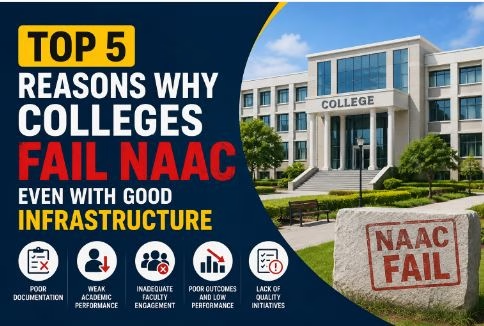
The Infrastructure Illusion — Why Good Facilities Are Not Enough
Every year, hundreds of colleges across India invest lakhs — sometimes crores — in new classrooms, laboratories, libraries, and smart boards. Yet when the NAAC Peer Team arrives, many of these very institutions walk away without the grade they expected. The question that haunts every Principal and IQAC Coordinator is: why colleges fail NAAC even when the physical infrastructure looks impressive.
The answer is rarely about the building. It is almost always about what is — or is not — documented, validated, and submitted. NAAC’s assessment framework evaluates quality across seven criteria, and physical infrastructure accounts for only a fraction of the total score. The rest depends on how effectively your institution captures evidence, maintains data integrity, and presents a consistent narrative through the Self Study Report (SSR).
Mantech Publications has been working closely with the academic community through its NAAC Accreditation Consulting Services, and one pattern emerges repeatedly: institutions that fail NAAC are not academically weak. They are documentation-weak. Below, we break down the top five systemic reasons behind NAAC failure — and what your institution can do about each one today.
Reason 1: Incomplete or Inconsistent SSR Documentation
The Self Study Report is not just a form you fill — it is the single most important document in your entire NAAC journey. Incomplete SSR documentation is the most commonly cited reason for grade deflation and outright failure. Many IQAC teams rush through the SSR submission, leaving metric responses vague, supporting documents missing, or quantitative inputs disconnected from the narrative.
The NAAC assessment framework requires specific, verifiable data for each metric. When Peer Team members cross-check the SSR against actual institutional records, discrepancies immediately raise red flags. Common documentation pitfalls include:
- Metric responses that describe intent rather than achieved outcomes
- Annexures attached but not referenced or explained in the main text
- Faculty data that does not match HR records
- Student satisfaction survey reports that are undated or show suspicious uniformity
- Research publications listed without DOI or proper journal indexing proof
Institutions that work with expert consultants who specialize in SSR Preparation Services are far better positioned to present a coherent, evidence-backed SSR that withstands the scrutiny of a Peer Team visit. BGC Global, a specialist NAAC accreditation consultancy, provides structured SSR preparation support designed specifically for IQAC Coordinators who need to transform raw institutional data into a compelling, compliant submission.

Reason 2: DVV Mismatches — When Your Numbers Tell a Different Story
Data Verification and Validation (DVV) is NAAC’s independent audit of the quantitative data you submit in the SSR. DVV mismatches occur when the figures in your SSR do not align with the supporting documents you upload, the data in your institution’s portals, or the records verified by NAAC’s empanelled officers.
This is the single most damaging stage for colleges that have “good infrastructure” but poor data management. Consider a scenario: a college claims 85% of students are enrolled in add-on certificate programmes in the SSR. During DVV, the officer asks for batch-wise attendance registers, course completion certificates, and affiliation approval letters for each programme. If even one document is missing or the numbers shift between tables, the entire metric is downgraded.
Common DVV mismatch situations include:
- Student-teacher ratio figures that differ between AQAR, IIQA, and SSR submissions
- Placement data with no offer letters, appointment orders, or employer verification
- Infrastructure values that differ from building completion certificates
- Expenditure on student welfare not matching CA-certified audited statements
- Faculty Ph.D. count inconsistent with degree certificates actually on file
To avoid these costly mistakes, institutions should conduct a pre-submission DVV audit. BGC Global offers dedicated DVV Clarification Support that reviews every quantitative metric before and after your SSR submission, reconciles numbers across all documents, and prepares structured clarification responses that protect your score during the DVV process.
🔍 Is Your SSR DVV-Ready?
Most colleges discover DVV mismatches only after submission — when it’s too late to fix them. BGC Global’s diagnostic mock audit identifies every number gap, missing document, and inconsistency in your SSR before the Peer Team does.
The Hidden Gaps — IQAC, Data Culture, and Website Non-Compliance
If Part 1 addressed documentation errors at the report level, Part 2 examines the deeper institutional habits that make NAAC failure almost inevitable — even for well-funded colleges. These are the issues that a good paint job cannot fix.
Reason 3: A Non-Functional or Under-Resourced IQAC
The Internal Quality Assurance Cell is not a committee that meets twice a year to sign off on the AQAR. NAAC expects the IQAC to be the nerve centre of your institution’s quality journey — actively monitoring outcomes, reviewing Best Practices, initiating feedback mechanisms, and maintaining a live evidence repository. When the Peer Team interviews faculty, students, and administrative staff, they quickly identify whether the IQAC exists on paper or in practice.
Many institutions fail NAAC not because they haven’t done good work, but because the IQAC never systematically captured that work. The result: years of genuine academic achievement simply go unrecorded and unsubmitted. Key IQAC failure patterns include:
- No documented minutes of IQAC meetings or action taken reports
- Feedback from students, parents, and employers collected but never analysed or acted upon
- Best Practices that exist informally but are never formally documented with impact evidence
- Annual Quality Assurance Reports (AQARs) filed late or with minimal data, creating a weak historical baseline for the SSR
- Departments operating independently with no centralised data collection protocol
Strengthening the IQAC before the SSR cycle begins is not just good governance — it is a strategic NAAC necessity. BGC Global’s IQAC Outsourcing and Establishment Services are designed for institutions that need to professionalize their IQAC operations quickly, with trained coordinators who understand exactly what NAAC looks for in a functional quality assurance system.
You can also explore Mantech Publications’ guidance on NAAC and NBA Accreditation Services to understand the dual accreditation landscape for technical and non-technical institutions.
Reason 4: Poor Data Consistency Across Reporting Cycles
NAAC’s assessment covers a five-year window. During that period, your institution submits AQARs annually, files an IIQA before the main assessment, and then compiles the SSR. Poor data consistency across these documents is a silent killer of grade scores.
Think of it this way: if your AQAR for 2020-21 reports 1,200 enrolled students, your IQAR mentions 1,240, and your SSR Criterion 2 table shows 1,185 — a Peer Team will note all three figures and formally question the discrepancy. Each such mismatch reduces confidence in the reliability of your data, which is itself assessed under several NAAC metrics related to institutional governance and transparency.
The problem typically originates from:
- No single owner for institutional data — different offices maintain different registers
- Manual data compilation that introduces transcription errors across documents
- Year-on-year AQARs prepared by different teams without a style or data guide
- Affiliation data, NIRF submissions, and NAAC data compiled in silos without cross-verification
- No pre-submission consistency check across the full documentation stack
BGC Global’s Accreditation Data Management Services create a unified institutional data architecture — so your AQAR, IIQA, SSR, and NIRF submission all tell the same, verified story. This single intervention eliminates the majority of DVV mismatches before they ever occur.
📋 Not Sure Where Your Data Gaps Are?
BGC Global offers a comprehensive Criteria-Wise Documentation Support service that audits your existing data trail and builds a consistent evidence base across all seven NAAC criteria.
—
Reason 5: Institutional Website Non-Compliance and Poor Digital Evidence Management
Many NAAC coordinators underestimate the role of the institutional website in the accreditation process. NAAC mandates public disclosure of a wide range of data — from fee structure and admission process to faculty qualifications, research output, and IQAC documents. A poorly structured website or one with broken links, outdated PDFs, and missing mandatory pages can directly cost you marks across multiple criteria.
During DVV and Peer Team visits, evaluators frequently attempt to independently verify SSR claims using the institution’s public website. If the website’s faculty profile page shows different qualifications from what the SSR states, or if the IQAC section is absent, it creates doubt about your entire submission. Specific compliance failures include:
- No dedicated NAAC/IQAC page with AQAR, SSR, and Peer Team report links
- Annual reports and audited financial statements absent or inaccessible
- Faculty research publications listed without indexing proof or DOI links
- Student grievance redressal mechanism and anti-ragging committee details missing
- Mandatory NIRF data not linked or outdated by more than one reporting year
Addressing this requires both a technical and strategic approach. BGC Global’s NAAC Website Compliance Services audit your existing website, restructure information architecture for NAAC compliance, and ensure all mandatory disclosures are properly structured, publicly accessible, and consistent with your SSR data.
🌐 Is Your Website NAAC-Ready?
A non-compliant institutional website silently costs marks across Criteria 1, 2, 4, and 6. BGC Global’s website audit tells you exactly what is missing and how to fix it before your Peer Team arrives.
The Path Forward — Turning NAAC Failure Into a Graded Accreditation
Understanding why colleges fail NAAC is the first step. The second — and far more important step — is acting on that understanding with a structured, time-bound remediation plan. Whether your institution has never attempted NAAC accreditation, was previously deferred, or is seeking to upgrade from a lower grade, the process requires expert guidance that goes beyond reading NAAC guidelines.
The NAAC accreditation framework was significantly revised with the introduction of the Binary and Graded Accreditation system. Many institutions that were previously accredited under the old framework are now realizing that the goalposts have moved. NAAC now places a far greater emphasis on outcomes, institutional processes, and the quality culture embedded in day-to-day academic operations — not just infrastructure.
For institutions navigating this shift, Mantech Publications’ Education guides and accreditation resources provide critical background reading on policy changes. Equally important is connecting with an accreditation specialist who works hands-on with institutions through every stage of the NAAC cycle.

What a Pre-NAAC Diagnostic Mock Audit Actually Covers
A diagnostic mock audit is not a theoretical review. When conducted by experienced NAAC consultants, it replicates the actual Peer Team evaluation process — criterion by criterion, metric by metric. Specifically, it examines:
- Completeness of SSR across all seven criteria with metric-level gap analysis
- Data consistency check: AQAR vs IIQA vs SSR vs website vs physical records
- DVV mismatch identification: every quantitative metric is independently verified against supporting documents
- IQAC process audit: meeting records, action taken reports, Best Practices documentation, feedback analysis
- Website compliance check: mandatory disclosures, NAAC portal data alignment, link integrity
- Peer Team interview readiness: common questions, how to present responses, document retrieval protocols
BGC Global — Bhavya Gyan Consultants — specializes exclusively in NAAC accreditation consultancy for colleges and universities across India. Their NAAC Accreditation Readiness Services are built around the understanding that each institution has a unique data history, infrastructure profile, and academic culture. A one-size-fits-all approach to NAAC preparation is precisely why so many colleges with genuine strengths still fail.
Why the Right Consultancy Partner Matters More Than You Think
There is no shortage of NAAC consultants in India. But there is a significant shortage of consultants who understand the difference between formatting an SSR and actually making an institution NAAC-ready. Principals and IQAC Coordinators who have gone through failed assessments consistently report one common experience: their consultants helped them write the SSR but never audited the underlying data or prepared the institution for the DVV and Peer Team scrutiny.
A genuine NAAC preparation partner does three things that most consultants skip:
- Conducts a reality check on your current data — not what you want it to say, but what it actually says
- Builds institutional capacity within your IQAC team so that the improvements outlast the accreditation cycle
- Prepares your leadership, faculty, and administrative staff for the direct interview process that happens during the Peer Team visit
This is exactly what BGC Global — Bhavya Gyan Consultants delivers through its end-to-end NAAC support model — from IQAC establishment and AQAR management to DVV clarification, SSR writing, and Peer Team Visit Preparation.
For institutions that also have technical programmes under consideration, Mantech Publications’ NBA Accreditation Services in India provide additional guidance on outcome-based education frameworks that align closely with NAAC’s quality culture requirements.
🎯 Ready to Close the Gap Between Your Infrastructure and Your NAAC Score?
BGC Global’s team of NAAC specialists has helped institutions across India identify hidden compliance gaps, fix data inconsistencies, and build documentation systems that deliver grades that match the real quality of your institution. Start with a no-obligation consultation today.
FAQs:
Q1. What is the most common reason why colleges fail NAAC in India?
The most common reason is not poor infrastructure or weak academics — it is incomplete SSR documentation and DVV mismatches. When the data submitted in the Self Study Report cannot be verified against supporting documents, NAAC assessors downgrade or reject those metrics, pulling down the overall score significantly.
Q2. How does DVV mismatch affect NAAC accreditation?
DVV (Data Verification and Validation) is NAAC’s independent audit of the quantitative data in your SSR. If the figures in your SSR do not match supporting documents, portal data, or records maintained on campus, NAAC officers reduce the metric score — sometimes to zero. A single DVV mismatch in a high-weightage metric like Criterion 2 (Teaching-Learning) or Criterion 3 (Research) can lower your grade by an entire tier.
Q3. What role does the IQAC play in NAAC accreditation?
The IQAC is the institutional backbone of NAAC preparation. It is expected to maintain a live, updated evidence repository, conduct regular quality audits, manage feedback systems, document Best Practices, and submit timely AQARs. A non-functional IQAC creates data gaps across multiple criteria and makes DVV compliance almost impossible.
Q4. Can a college with good infrastructure still fail NAAC?
Yes, and it happens frequently. Good infrastructure addresses primarily Criterion 4 (Infrastructure and Learning Resources), which carries a specific but limited weightage. The other six criteria — including Teaching-Learning, Research, Extension, Governance, and Student Support — depend heavily on documentation quality, data consistency, and IQAC processes that infrastructure alone cannot address.
Q5. What is a diagnostic mock audit for NAAC, and why is it recommended?
A diagnostic mock audit replicates the NAAC Peer Team evaluation process before your actual assessment. Conducted by NAAC specialists, it examines your SSR, verifies data against supporting documents, identifies DVV mismatches, checks IQAC functionality, and reviews website compliance. It gives your institution a clear, actionable picture of exactly where you stand — and what needs to be fixed — before the real Peer Team arrives.
External Resources & References
The following authoritative external resources were referenced in the preparation of this article. These links are provided for informational purposes and are recommended reading for IQAC Coordinators, Principals, and accreditation teams.
- NAAC Official Website — Assessment & Accreditation Framework:
- NAAC Self Study Report (SSR) Template & Guidelines:
- University Grants Commission (UGC) — Quality Mandates for HEIs:
- NIRF India Rankings — National Institutional Ranking Framework (MHRD/MoE):
This blog was published by Mantech Publications — Empowering Research & Knowledge. Mantech Publications provides expert NAAC and NBA accreditation consulting services, academic publishing support, and research assistance for institutions across India.
Visit us: mantechpublications.com | For NAAC consultancy: bgcglobal.in
Leave a Reply