

Every research paper you read in a good journal has passed through a quiet, unglamorous filter. That filter is peer review. For a first-time author, it can feel like a black box. You upload a file, wait for weeks, and then receive a decision you did not expect.
It does not have to feel that way. The peer review process steps are logical and repeatable. Once you understand what happens at each stage, you can plan your timeline, write better cover letters, and respond to reviewers with confidence.
This guide walks through the full journey, from the day you click submit to the day your paper gets a DOI. It is written for research scholars, PG students, and faculty members in Indian colleges and universities who want a clear, practical picture.
What Peer Review Actually Does

Peer review is an expert quality check. Independent specialists in your field read your manuscript and judge whether the work is sound, original, and clearly reported.
They are not there to praise you. They are there to test your claims. A good reviewer asks three questions. Is the method appropriate? Do the results support the conclusions? Has this been said before?
This matters beyond your own career. Peer review is what separates a credible journal from a predatory one. It is also the reason accreditation bodies and funding agencies treat peer-reviewed output as evidence of real research capacity. If you are choosing where to publish, start by reading the journal’s editorial guidelines and its publication ethics policy before you look at anything else.
Peer Review Process Steps: The Full Journey
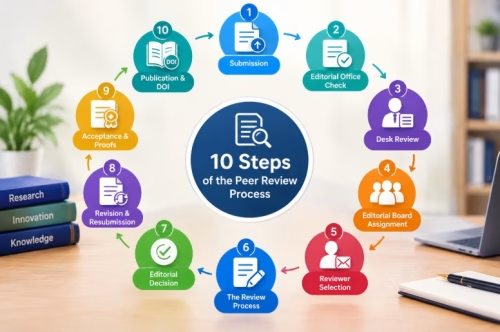
Different journals use different software, but the sequence is broadly the same everywhere.
Step 1: Manuscript Submission
You upload your manuscript, figures, tables, and author details through the journal’s portal. Most journals also ask for a cover letter and a declaration that the work is not under review elsewhere.
Formatting matters more than authors expect. Wrong reference style, missing ethics statements, or an over-length abstract can cost you two weeks before a reviewer even sees the paper. Read the author submission guidelines line by line, then submit your manuscript.
Step 2: Editorial Office Check
The editorial office runs a technical screening. Staff check file completeness, author declarations, plagiarism similarity scores, and scope fit.
Papers fail here for dull reasons. Missing author affiliations. No conflict-of-interest statement. A similarity index above the journal’s threshold. Nothing about your science is judged yet.
Step 3: Desk Review by the Editor
Next, a handling editor reads the paper properly for the first time. The question now is scope and significance. Does this belong in this journal, and is it strong enough to justify reviewer time?
A desk rejection at this stage is disappointing but useful. It arrives in days, not months, and it frees you to submit elsewhere quickly.
Step 4: Assignment to the Journal Editorial Board
If the paper clears desk review, it is assigned to a subject specialist. This is where the journal editorial board earns its keep.
An editorial board is a panel of academics and practitioners who cover the journal’s subject areas. The board member handling your paper decides who is qualified to review it, weighs the reviews once they arrive, and makes the final recommendation. A journal with a thin or anonymous board is a warning sign. You can see how a genuine board is structured on the Mantech editorial board page.
Step 5: Reviewer Selection and Invitation
The editor now invites two or three reviewers. They look for people with matching expertise and no conflict of interest, which rules out co-authors, colleagues at the same institution, and recent collaborators.
This step is often the slowest. Reviewers are unpaid and busy. Several may decline before two accept. Two to four weeks here is normal and is not a sign that anything is wrong.
Step 6: The Review Itself
Reviewers read the manuscript in detail and write a structured report. Most journals ask them to comment on originality, methodology, results, clarity, and references.
They then recommend one of four outcomes: accept, minor revision, major revision, or reject. Accept without changes is rare. Treat a major revision as good news, because it means the editor still sees a publishable paper underneath.
Step 7: The Editorial Decision
The editor reads all reports together. Reviewers frequently disagree, and when they do, the editor may bring in a third reviewer or use their own judgement.
You receive a decision letter with the anonymised reviewer comments attached. Read it twice. The first read is emotional. The second read is where the actual instructions become visible.
Step 8: Manuscript Revision and Resubmission
The manuscript revision stage is where most papers are won or lost. You resubmit two things: the revised paper and a point-by-point response letter.
The response letter is the document editors actually read closely. Quote each comment, state exactly what you changed, and give the page and line number. Where you disagree, say so politely and explain why, with evidence. Silence on a comment reads as evasion.
Many Indian institutions now run internal support for exactly this stage, because a well-handled revision can turn a borderline paper into an accepted one. If your team needs structured help with writing and revision, look at research paper assistance services or institution-level faculty publication guidance.
Step 9: Acceptance, Copyediting, and Proofs
Once the editor is satisfied, you get an acceptance letter. The paper then moves to production for copyediting, typesetting, and reference checks.
You will receive proofs to approve. This is your last chance to fix errors, and it is for corrections only, not new content. You will also sign a copyright transfer form at this point.
Step 10: Publication, DOI, and Indexing
Your article is assigned to an issue, given a DOI, and pushed to indexing services. The DOI is the permanent link that makes your work citable and traceable for the rest of its life.
Accurate metadata is what gets you discovered. Author names, affiliations, ORCID, keywords, and references all need to be correct at this stage. Journals that take this seriously offer proper DOI and metadata services rather than treating it as an afterthought.
Ready to submit?
Single-Blind vs Double-Blind Review: What Is the Difference?
Journals differ in who knows whose identity. Understanding the single-blind vs double-blind distinction helps you set expectations and prepare your files correctly.

Single-Blind Review
Reviewers know who the authors are, but authors do not know who the reviewers are. This is still the most common model in science, engineering, and medicine.
The advantage is context. A reviewer can check whether the authors have declared related prior work. The drawback is bias. Reputation, institution, gender, and country of origin can all colour a review, even unconsciously.
Double-Blind Review
Neither side knows the other’s identity. This model is common in management, social sciences, and humanities.
It reduces bias against unknown authors and smaller institutions, which is why many early-career researchers in tier-2 and tier-3 colleges prefer it. It is not foolproof, though. Self-citations, distinctive methods, and dataset descriptions often reveal who wrote the paper anyway.
If you submit to a double-blind journal, you must prepare an anonymised manuscript. Strip author names from the file, remove identifying acknowledgements, clean the document properties, and refer to your own earlier work in the third person.
Open and Transparent Review
A growing number of journals publish the reviewer reports alongside the article, sometimes with reviewer names. This improves accountability and gives new researchers a rare chance to see what a real review looks like. Adoption in India is still limited but rising.
How Long Does Peer Review Take?

Timelines vary widely by discipline and journal, but a realistic pattern looks like this.
Technical screening takes a few days. Desk review takes one to two weeks. Reviewer invitation and review takes three to eight weeks. The editorial decision follows within a week or two of the last report. Your revision takes as long as you take. Production and publication add another two to six weeks.
For most journals, submission to publication runs somewhere between two and six months. Anyone promising acceptance in 48 hours is not running peer review. They are selling a slot. If you are comparing options, the list of peer-reviewed journals and the paper publication process pages are a good benchmark for what honest timelines look like.
Why Peer Review Now Matters More to Institutions
Something important changed for Indian higher education. The UGC discontinued the centralised UGC-CARE journal list in February 2025 and moved to suggestive parameters instead.
The practical effect is that institutions can no longer outsource the judgement. Colleges and universities are now expected to form their own internal committees, assess journal quality themselves, evaluate editorial board credibility and peer review rigour, and issue clear guidance to their faculty and students.
That is a real administrative burden, and it lands on the IQAC. It also connects directly to accreditation. Research publications feed NAAC Criterion 3, NBA documentation, and NIRF research metrics. If your faculty publish in journals that cannot demonstrate a genuine review process, that evidence becomes hard to defend in front of a peer team.
What Institutions Should Put in Place
Start with a written journal selection policy that your departments actually follow. Add a verification checklist covering ISSN, editorial board transparency, indexing claims, and stated review model. Train your faculty so the policy is understood rather than filed. Then keep publication evidence organised throughout the year instead of scrambling before submission deadlines.
Most colleges find the training piece hardest. Structured research methodology workshops and editorial process awareness sessions help faculty understand publishing from the inside, which in turn improves the quality of what they submit. Broader research support services for institutions cover documentation and profile management alongside it.
Building a journal quality policy after the UGC-CARE change?
Get your research documentation audit-ready.
Common Reasons Papers Get Rejected
Rejection is normal. Most rejections trace back to a short list of avoidable problems.
Scope mismatch is the most common. The paper is fine, but it belongs in a different journal. Weak methodology comes next, usually small samples, no control, or missing statistical justification. Then come incremental findings that add little to existing literature, poor English that obscures otherwise good work, sloppy referencing, and undeclared ethics approvals.
Three of those six are fixable before you submit. Check scope against the journal’s aims. Get a colleague outside your immediate group to read the paper. Verify every reference resolves. Authors who do this consistently see fewer desk rejections, and the author benefits and support offered by serious publishers exist largely to catch these issues early.
A Pre-Submission Checklist

Run through this before you upload anything.
Confirm the journal’s scope genuinely matches your topic. Format references in the required style. Check the similarity index yourself. Confirm all co-authors have approved the final version and agreed the author order. Include ethics approval and funding statements. Anonymise the file if the journal is double-blind. Write a cover letter that states your contribution in three sentences. Keep a clean copy of the submitted version for your records.
Eight items. Twenty minutes. It saves weeks.
Building Publishing Skills Early
Peer review is a skill students should meet before their doctorate, not during it. Postgraduate and doctoral programmes increasingly require a published paper for award, and students who understand review culture early publish faster.
If you are still choosing a research pathway, compare PhD programs in India and doctoral engineering courses to see which programmes carry publication requirements and what they expect from you.
Faculty and scholars who want end-to-end support, from drafting to DOI, can review our paper publication services and check turnaround before committing.
Conclusion
Peer review is not a hurdle placed in front of your work. It is the process that makes your work worth citing. Once you can name each stage, from technical screening through editorial decision to DOI assignment, the waiting becomes manageable and the feedback becomes usable.
Submit to journals that publish their review model openly. Revise thoroughly rather than quickly. And if you are responsible for research quality at an institution, put a journal selection policy in place now that the central list no longer exists.
Publishing a departmental volume or conference output this year? Explore conference proceedings publishing, or request an institutional consultation with BGC to align your research documentation with accreditation requirements.
FAQs:
Most journals use two or three independent reviewers, with a third added only when the first two disagree.
Closer to acceptance. It signals the editor sees a publishable paper that needs substantial work first.
Many journals allow suggestions, but editors verify independence and are free to ignore your list entirely.
In single-blind, reviewers know the authors. In double-blind, both sides stay anonymous to reduce bias.
Journals typically allow 30 to 60 days for major revisions and 14 days for minor ones.
Software screening catches most of it. Reviewers sometimes spot undisclosed overlap that software misses.
Yes, but withdraw formally and before acceptance. Late withdrawals damage your standing with that journal.
The board sets scope, selects reviewers, weighs conflicting reports, and takes final responsibility for decisions.
No. Many legitimate open-access journals charge fees. The warning sign is guaranteed or instant acceptance.
Yes. Both frameworks assess research output, and journal credibility affects how that evidence is scored.
External Resources
- Committee on Publication Ethics (COPE) — global guidelines on ethical editorial and peer review practice.
- ICMJE Recommendations — authorship criteria and manuscript preparation standards.
- University Grants Commission (UGC) — official notifications on journal quality parameters in India.
- Crossref — how DOIs and scholarly metadata registration work.
- Directory of Open Access Journals (DOAJ) — a vetted index for checking open-access journal credibility.
- World Association of Medical Editors (WAME) — resources on identifying predatory journals.
- ORCID — persistent researcher identifiers used across submission systems.
Leave a Reply