

Your college already has a NAAC grade. That puts you in a different spot than a first-time applicant. You are not starting from zero. You are deciding what to do with something you already earned. Across India, many Cycle 2, 3, and 4 institutions are rushing to drop their old grade and jump straight into the new Binary Accreditation and MBGL system. In most cases, this is the wrong move. A grade earned under the old Revised Accreditation Framework still carries real weight with funding bodies, affiliating universities, and parents. Letting it expire before you are ready wastes years of documented work. This guide walks through the NAAC Cycle 2 guidelines around legacy grade retention, explains why timing your transition matters more than speed, and shows how unplanned transition phase fees quietly punish institutions that move too fast.
What “Cycle 2 and Above” Really Means
A Cycle 1 institution is applying for NAAC accreditation for the very first time. It has no prior grade, no CGPA history, and nothing to protect. A Cycle 2, 3, or 4 institution is different. It already holds a valid grade from an earlier assessment and is now preparing for reaccreditation. This single difference changes the entire strategy. Cycle 1 colleges can move as soon as they meet the eligibility criteria, since there is no downside to applying early. Cycle 2+ colleges carry an asset that a rushed application can put at risk.
If your institution holds a valid A, A+, B++, or any other Revised Accreditation Framework grade, treat that grade as an institutional asset, not paperwork to discard. It affects eligibility for UGC schemes, participation in NIRF rankings, and how confidently your admissions team can speak to prospective students and parents. For the complete picture of how the old RAF system maps onto the new Binary Accreditation and MBGL framework, our detailed breakdown of NAAC’s new accreditation system and transition groups covers every transition scenario in depth.
The CGPA Legacy Your College Already Earned

Why Your Existing Grade Still Has Value
Under the old Revised Accreditation Framework, institutions were scored across seven criteria and given a Cumulative Grade Point Average on a 0 to 4 scale. That CGPA score, converted into a letter grade from A++ down to C, was never just a number on a certificate. It came from years of documented evidence: research output records, governance minutes, student support systems, infrastructure proof, and placement data. None of that underlying evidence disappears the day the new framework arrives.
That evidence becomes the foundation your institution will use to prepare for Binary Accreditation and, later, for MBGL levels if you choose to pursue them. Institutions that treat their current CGPA grade as outdated paperwork often discard usable evidence instead of updating it. A smarter approach is to carry that evidence forward. Update the numbers, cross-check them against AISHE and NIRF records, and reuse the structure your IQAC already built for the last cycle. Starting completely from scratch, when you do not have to, wastes both time and institutional memory that your team spent years building.
NAAC Cycle 2 Guidelines: What the Transition Rules Actually Say
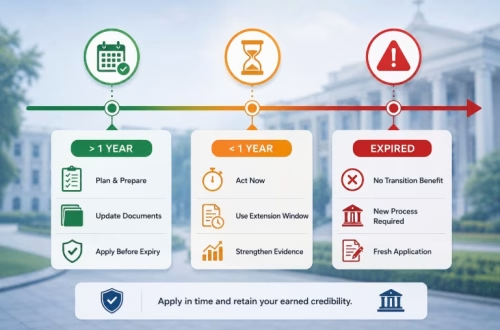
Every currently accredited institution falls into a transition group based on how much validity remains on its RAF grade. This is the part most Cycle 2+ colleges get wrong. They assume they must apply for Binary Accreditation immediately, even while their old grade is still active and valid. That assumption is rarely correct, and acting on it early can cost you more than it saves.
| Your Grade Status | What This Means for Your College |
| More than one year of validity left | Use the remaining time to prepare properly. Apply for Binary Accreditation before the grade expires, not after it lapses. |
| Less than one year of validity left | You typically get a short extension window. Preparation must start now, not once the portal opens. |
| Grade already expired | The transition benefit is lost. Your institution must apply completely fresh, with no grandfathering of the old grade. |
The safest rule for Cycle 2 and above institutions is simple. Never let your existing grade lapse before you are ready to apply for Binary Accreditation. Doing so erases years of accumulated credibility overnight, and pushes your institution into the same starting position as a college that was never accredited at all. That is an avoidable setback, not an inevitable one.
Why Rushing Into Binary Accreditation Can Cost You
The Data-Mismatch Risk
The new framework checks your submitted data automatically against AISHE, NIRF, and UDISE+ records through the One Nation One Data Platform. If your placement numbers, faculty count, student intake, or research output figures do not match across these databases, your institution’s credibility score drops before a single human reviewer looks at your file. Institutions that rush their application without reconciling this data first are often flagged at the very first automated check.
Losing Your Comparative Advantage
A valid A or A+ grade still carries real weight with parents, funding bodies, and affiliating universities. Giving that status up too early, before your Binary readiness is genuinely solid, means your institution operates with no accreditation status at all during the gap. That gap can hurt admissions, grant eligibility, and NIRF participation in the very academic year it happens.
Not sure if your institution should apply now or wait?
Book a NAAC transition readiness audit with BGC and get a clear answer based on your actual documentation status, not guesswork.
Transition Phase Fees: The Hidden Cost of Timing It Wrong
Institutions rarely budget properly for the real cost of switching frameworks. Transition phase fees cover the application cost for Binary Accreditation, and for each MBGL level afterward if your institution chooses that path. Because every MBGL level needs its own three-year renewal, poor timing often means paying twice over. First, for a rushed and incomplete application that gets marked “Awaiting Accreditation.” Second, for the corrected reapplication a year later, along with the internal cost of repeating the same documentation exercise.
A college that reconciles its documentation before applying avoids this repeat cost entirely. It also avoids the hidden internal cost of pulling faculty, department heads, and IQAC staff into last-minute, disorganized data collection during peak semester months. When management budgets for accreditation, it should plan for the full cycle, including a contingency for reapplication, rather than assuming a single, smooth submission.
Get a realistic fee and timeline estimate before your management commits budget. Talk to BGC’s accreditation team about Binary Accreditation and MBGL costs so your trustees can plan with real numbers instead of estimates.
A Practical Retention Roadmap for Cycle 2+ Institutions
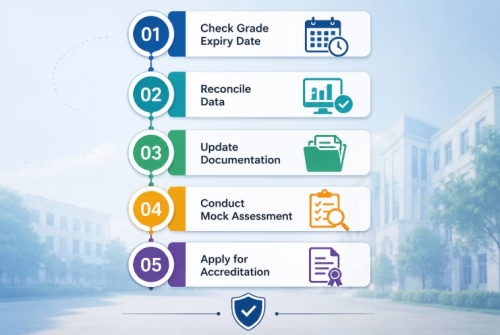
Follow this sequence instead of applying under pressure or reacting to portal announcements at the last minute.
- Step 1: Confirm your exact grade expiry date and identify your transition group before doing anything else. This single fact should drive your entire timeline.
- Step 2: Audit your AISHE, NIRF, and UDISE+ data against your internal institutional records now, while your RAF grade is still valid and there is no submission deadline pressure.
- Step 3: Update your IQAC documentation across all seven criteria, using your last Self-Study Report as the starting point rather than a blank file. Most of the structure already exists.
- Step 4: Run an internal mock assessment against the new 10-attribute framework before the real submission, so gaps surface internally rather than during the official review.
- Step 5: Apply for Binary Accreditation only once documentation gaps are closed, ideally with several months of validity still remaining on your current grade as a safety margin.
This sequence protects your existing CGPA-based grade while you build a stronger, verified case for Binary Accreditation. Need a criteria-wise documentation gap analysis before you apply?
Where Research Output Strengthens Your Next Cycle
Criterion 3 of NAAC evaluation looks closely at research, innovation, and extension activity. This is one area where Cycle 2 and above institutions often have more to show than they realize, but the proof is scattered across departments, personal folders, and outdated CVs. Peer-reviewed publication in indexed journals, consistent faculty research output, and properly documented consultancy work all strengthen this criterion directly.
Our journal subscription and paper publication services help faculty build a steady, verifiable publication record ahead of reaccreditation, rather than a rushed scramble of last-minute submissions in the final months before your SSR is due.
A strong, well-documented accreditation history also shapes how outside audiences view your institution long before an inspector ever visits. Students comparing accredited colleges and courses, for instance on platforms like BhavyaGyan, routinely use NAAC status as a first filter before shortlisting an institution. Retaining and building on your existing grade protects that visibility, alongside the funding and ranking benefits.
How This Fits Your Institution’s NIRF and Autonomy Plans
Reaccreditation rarely happens in isolation. Most Cycle 2 and above institutions are also tracking NIRF rankings, applying for graded autonomy, or renewing state affiliation at roughly the same time. Each of these processes leans on the same underlying data: faculty strength, research output, student outcomes, and infrastructure records. If your NAAC transition is rushed and your data does not reconcile cleanly, the damage spreads beyond the accreditation file itself.
An institution with a stable, valid grade and clean underlying data has more room to sequence these applications sensibly. It can time its NIRF submission, its Binary Accreditation application, and any autonomy request so each one supports the others instead of competing for the same stretched documentation team during the same quarter. Institutions that plan across these processes together, rather than treating each as a separate fire to put out, tend to submit stronger applications with fewer last-minute corrections.
This is exactly where retaining your legacy RAF grade buys you room to plan properly. A grade that is still valid gives your IQAC breathing space to sequence NIRF, autonomy, and Binary Accreditation work without one deadline forcing shortcuts on another.
Common Mistakes Cycle 2 Colleges Make During Transition
Most transition problems are avoidable and repeat across institutions of very different sizes and disciplines. Watch for these patterns in your own preparation cycle:
- Letting the RAF grade expire before Binary preparation has even begun
- Assuming old SSR documentation is submission-ready without updating it first
- Ignoring AISHE and NIRF data mismatches until the new portal flags them automatically
- Treating MBGL as mandatory, when it is actually optional after Binary Accreditation
- Budgeting for a single application fee instead of planning for a possible reapplication cycle
Conclusion
Cycle 2 and above institutions hold something Cycle 1 applicants do not: a proven, documented grade built over years of institutional work. The smartest move is not to rush past that grade. It is to use the time your current CGPA-based status still gives you, close your documentation gaps deliberately, and apply for Binary Accreditation on your own institution’s schedule rather than under last-minute pressure.
Treat your legacy RAF grade as working capital, not an expiry date to beat. Spend the months it still gives you on real preparation: reconciled data, updated evidence, and a documentation system your IQAC can maintain long after this cycle closes. Read our strategic advisory on timing your next accreditation cycle, and build a transition plan that protects the grade your institution already earned.
FAQs:
Cycle 1 applies for the first time. Cycle 2+ already holds a grade and seeks reaccreditation.
No. Apply for Binary Accreditation before your existing grade expires, if possible.
No. MBGL is optional. Institutions can stay at Binary status for its full validity.
Costs for applying under the new framework, including possible reapplication if rushed.
Yes. It stays valid until expiry, and its evidence supports your Binary application.
Mismatches with AISHE or NIRF lower your credibility score automatically, before review.
Immediately, while the current RAF grade is still valid, not after it expires.
External Resources and References
- NAAC Official Website: naac.gov.in
- AISHE Portal: aishe.gov.in
- NIRF Portal: nirfindia.org
Leave a Reply