

Engineering colleges answer to two different accreditation bodies when it comes to their library, and each one looks at it slightly differently. NAAC evaluates your library at the institutional level, while NBA examines it program by program, with particular attention to how well it supports the specific engineering disciplines you teach. This guide walks through what a modern engineering college library actually needs to satisfy both. For a detailed breakdown of journal subscription budgeting strategies specifically, our earlier guide covers that ground in depth; this post focuses on the library as a whole, physical space, digital resources, staffing, and journal coverage together.
A library built only to satisfy a checklist rarely serves students well day to day. The goal here is a library that genuinely supports engineering coursework and research, while also holding up cleanly under NBA and NAAC review.
🚀 Ready to build a discipline-matched journal collection for your engineering programs? Request a customized list of 90+ indexed journals for engineering today.
Why Library Quality Directly Affects Accreditation Scores
Libraries are one of the few evaluation areas where documentation and physical reality are checked together, in the same visit. A well-written narrative about your library’s resources means little if an assessor walks in and finds outdated journals, empty reading rooms, or a librarian who cannot explain how digital resources are accessed. This is precisely why library planning deserves the same structured attention as SSR or SAR drafting, rather than being treated as a background infrastructure item.
Engineering programs face an additional layer of scrutiny here, since NBA assessors are typically subject specialists themselves. A civil engineering panel member will notice quickly whether your library’s civil engineering holdings are current and relevant, not just present in the catalogue.

Why Engineering Colleges Need Library Planning That Satisfies Both NBA and NAAC
NAAC assesses your library as part of the institution-wide SSR, generally under Criterion 4, looking at library resources across every department together. NBA, by contrast, evaluates library adequacy as part of each program’s Self-Assessment Report, checking whether the library specifically supports that engineering discipline’s curriculum and research needs. Our partner guide on SAR preparation for NBA accreditation explains this program-wise structure in more detail if you are preparing both submissions in parallel.
This means a library that looks adequate at the institutional level for NAAC can still fall short for a specific NBA program review, if that department’s journals, reference material, or digital resources are thin relative to its curriculum. Planning for both from the start avoids rebuilding your library evidence twice.
NBA Library Requirements: What Assessors Actually Look For
Understanding NBA library requirements starts with knowing what assessors physically check during a visit, not just what appears in your SAR narrative. Since NBA evaluation happens program-wise, the same institutional library can score differently across departments depending on how well its holdings map to each program’s specific curriculum.
- Library space, reading area, and seating capacity, checked against AICTE norms for your student strength
- Verified usage data, typically through gate registers, barcode systems, or digital attendance logs, showing the library is genuinely used, not just stocked
- Discipline-specific journal and reference material coverage, checked against each program’s curriculum rather than the institution’s library as a whole
- Digital resources and modern learning infrastructure, which now carry more weight under NBA’s 2025 SAR format than in earlier assessment cycles
- Library automation and cataloguing systems, since manual, unsearchable records reflect poorly during evaluation
📚 Preparing your engineering department’s SAR alongside your library upgrade? Read our SAR Preparation Guide for NBA Accreditation.
NAAC Criterion 4 and the Library: What’s Different
NAAC’s evaluation places specific weight on peer-reviewed print journals and their digital equivalents, judged on peer review status, ISSN registration, and recognised indexing, not on whether the publisher is Indian or international. This gives engineering colleges genuine flexibility in how they build a compliant, budget-appropriate journal collection.
- Journals must be peer-reviewed and carry a valid ISSN to count as credible evidence
- Indexing in recognised databases strengthens a journal’s standing during DVV review
- A mix of print and digital subscriptions is acceptable, and often practical for institutions with variable internet connectivity
- Subscription continuity matters; a lapsed or inconsistent subscription history weakens Criterion 4 evidence more than a smaller but consistent collection
Journal Subscription for Engineering: What to Prioritise
Building the right journal subscription for engineering departments means matching your subscription list to your actual programs, not subscribing broadly and hoping it covers everyone.
- Ensure every engineering department, civil, mechanical, electrical, electronics, and computer science, has at least one dedicated, discipline-relevant subscription
- Include at least one multidisciplinary or general engineering title that supports interdisciplinary research and project work
- Balance print subscriptions, useful for reading rooms and offline access, with digital access for remote and after-hours use
- Review subscriptions annually against curriculum changes, since new electives or specialisations can outgrow an older subscription list quickly
For a full walkthrough of budgeting this across a Tier-3 institution’s constraints, our earlier guide on affordable college journal subscription strategies covers cost planning in detail.
📖 Want a subscription list matched specifically to your engineering programs? Request a customized list of 90+ indexed journals for engineering.
AICTE Norms for Physical Library Infrastructure
Physical infrastructure still forms the backbone of NBA and NAAC library evaluation, governed largely by AICTE norms for space and capacity. These norms exist precisely because a library’s usefulness is inseparable from its physical adequacy; no amount of digital access fully substitutes for a functional, well-staffed reading space during peak examination periods.
- Adequate floor area and reading room capacity scaled to your sanctioned student intake
- A qualified, full-time librarian, supported by trained assistant staff for a library of meaningful size
- Extended working hours, particularly during examination periods, since limited hours are a common evaluator observation
- Proper shelving, ventilation, and lighting standards that keep the space genuinely usable, not just present on paper
Institutions preparing for their next NBA or NAAC cycle should treat a physical infrastructure walkthrough as seriously as their documentation review, since assessors form an immediate impression the moment they enter the library.
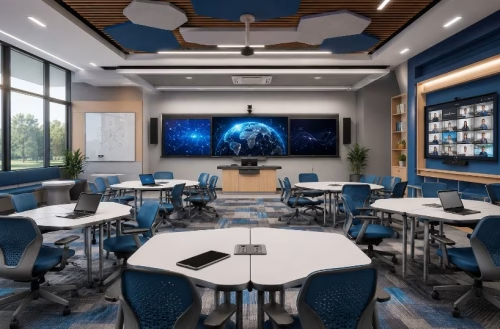
Digital-First Additions: What a Modern Engineering Library Needs Beyond Books
A genuinely modern library goes beyond print collections and physical seating. These additions increasingly separate a strong library from an adequate one during evaluation, and they matter just as much to daily student use as they do to assessment scores.
- Remote access to e-journals and digital databases, so students and faculty can use resources outside library hours
- An institutional repository for student projects, theses, and faculty research output
- Integration with national digital resources and open courseware platforms relevant to engineering education
- RFID or barcode-based library automation, replacing manual issue registers with searchable, auditable digital records
🖥️ Building out your library’s digital resource layer alongside your print collection? Request a customized list of 90+ indexed journals for engineering to anchor your subscription plan first.
Building a Library Development Plan: A Practical Checklist
- Map current journal and reference holdings against each engineering department’s curriculum individually
- Confirm reading room and seating capacity against AICTE norms for your current student strength
- Verify librarian staffing and working hours meet both NBA and NAAC expectations
- Set up or upgrade library automation for searchable, auditable usage records
- Build a subscription review cycle tied to your academic calendar, not a one-time purchase
- Document library usage data consistently, since both NBA and NAAC expect proof of genuine use, not just holdings
Conclusion
A modern engineering college library is built around two audiences at once: the students and faculty who use it daily, and the NBA and NAAC assessors who will eventually evaluate it. Getting both right comes down to the same fundamentals: adequate physical space, discipline-matched journal subscriptions, genuine digital access, and usage records that prove the library is actually being used. Institutions that plan their library this way rarely face last-minute scrambling before an assessment visit, and they end up with a resource students genuinely rely on year-round, not just during evaluation season.
Start with your current holdings mapped against each department’s curriculum, and build outward from there. Our earlier guide on affordable college journal subscription strategies is a useful next stop for budgeting the subscription side of this plan.
FAQs:
NAAC assesses the library institution-wide; NBA evaluates it program by program.
No, peer-reviewed, ISSN-registered, indexed journals of any origin qualify.
Adequate space, seating capacity, staffing, and working hours scaled to student intake.
At least one relevant title per department, plus multidisciplinary coverage.
Yes, digital resources now carry significant weight alongside print holdings.
Leave a Reply