
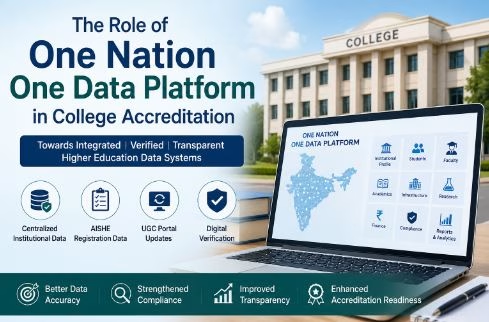
One Nation One Data Platform is emerging as one of the most significant digital initiatives for India’s higher education ecosystem. As regulatory authorities continue moving towards centralized digital governance, colleges and universities are expected to maintain accurate, standardized, and verifiable institutional data across multiple government portals.
For principals, IQAC coordinators, directors, department heads, and accreditation teams, this shift means that institutional data can no longer exist in isolated spreadsheets or disconnected reports. Information submitted to AISHE, UGC, NAAC, NIRF, AICTE, and other regulatory platforms must remain consistent, updated, and digitally verifiable.
Institutions preparing for accreditation increasingly realize that documentation quality alone is no longer enough. Data integrity, digital verification, timely updates, and inter-departmental coordination have become equally important. This blog explains how One Nation One Data Platform supports accreditation readiness, why colleges should prepare for integrated digital reporting, and what practical steps institutions can take to strengthen compliance.
Request expert documentation audit for stronger accreditation readiness today.
1. What is One Nation One Data Platform?
Higher education in India generates enormous volumes of institutional information every year. Colleges regularly submit data relating to:
- Student admissions
- Faculty appointments
- Academic programs
- Examination results
- Research activities
- Infrastructure
- Financial resources
- Governance
- Accreditation status
- Institutional development
Historically, these datasets have often been reported separately to different regulatory bodies, resulting in duplication, inconsistencies, and significant administrative workload.
The concept of One Nation One Data Platform seeks to simplify this process by encouraging standardized institutional data management across multiple educational systems. Instead of preparing different versions of the same information for different agencies, institutions are encouraged to maintain one reliable source of verified institutional data that can support reporting across various regulatory requirements.
Although different agencies continue to have their own reporting mechanisms, the overall direction of digital governance in higher education is toward greater interoperability, reduced duplication, and improved data consistency.
For accreditation teams, this represents an important change in approach. The focus shifts from preparing documents only during accreditation cycles to maintaining continuously updated institutional information throughout the academic year.
Objectives of a Unified Data Platform
A unified institutional data ecosystem aims to:
- Reduce duplicate data submissions
- Improve data accuracy
- Enable digital verification
- Increase transparency
- Support evidence-based policymaking
- Simplify institutional reporting
- Strengthen regulatory compliance
- Improve accreditation readiness
Rather than viewing data submission as an annual exercise, institutions are encouraged to establish systematic processes for collecting, validating, and updating information on an ongoing basis.
How It Relates to Accreditation
Accreditation agencies increasingly rely on authentic institutional evidence. Much of this evidence originates from digital records rather than manually prepared documents.
Examples include:
- Faculty databases
- Student enrolment statistics
- Research publications
- Financial statements
- Academic calendars
- Examination records
- Infrastructure inventories
- Learning management systems
- Institutional websites
- Official government portals
When institutional information remains consistent across these sources, accreditation teams spend less time resolving discrepancies and more time demonstrating quality initiatives.
Digital Verification Is Becoming More Important
Traditional accreditation often depended heavily on printed documentation.
Today, verification increasingly includes:
- Online institutional profiles
- Government databases
- Digital faculty records
- Official notifications
- Institutional websites
- Academic management systems
- Research databases
- Public disclosure information
This means documentation quality now depends not only on the documents themselves but also on whether the underlying data is accurate and consistently maintained.
2. Why One Nation One Data Platform Matters for Colleges and IQAC Teams
Accreditation is fundamentally evidence-driven. Every claim made in an institutional report should be supported by authentic documentation and reliable data.
As educational governance becomes increasingly digital, institutions that maintain organized, verified, and centralized records are better positioned to respond to accreditation requirements efficiently.
Better Data Consistency
One of the biggest challenges during accreditation is inconsistent reporting.
For example:
- Student numbers differ between departments.
- Faculty records vary across reports.
- Research publications are counted differently.
- Infrastructure inventories are outdated.
- Financial information is inconsistent.
These discrepancies create unnecessary questions during assessment.
A centralized data management approach significantly reduces these issues by ensuring that all departments rely on the same verified information.
Improved IQAC Functioning
IQAC teams coordinate information from nearly every department within an institution.
Without standardized data collection, IQAC members often spend months:
- requesting missing files,
- correcting inconsistencies,
- validating statistics,
- compiling evidence.
When institutional data is continuously maintained in an organized manner, IQAC can focus more on quality enhancement than on documentation recovery.
Supports AISHE Registration Data
Annual submission of AISHE registration data requires institutions to maintain updated information regarding:
- student enrolment,
- faculty,
- infrastructure,
- academic programs,
- finance,
- examination outcomes.
Maintaining this information throughout the year reduces last-minute reporting challenges and improves overall institutional accuracy.
Easier UGC Portal Updates
Many institutions manage multiple regulatory submissions simultaneously.
Regular UGC portal updates require colleges to maintain current information regarding:
- recognition status,
- academic programs,
- faculty,
- governance,
- statutory approvals,
- institutional changes.
When institutional records are centralized, updating regulatory portals becomes faster and more reliable.
Better Digital Verification
Digital verification has become an essential part of institutional credibility.
Examples include:
- faculty qualification records,
- official approvals,
- research publications,
- website disclosures,
- accreditation reports,
- financial transparency,
- statutory compliance.
Well-organized digital records help institutions respond confidently to verification requests from regulatory agencies.
Supports Multiple National Frameworks
A robust institutional data management system benefits several quality initiatives simultaneously, including:
- NAAC Accreditation
- NBA Accreditation
- NIRF Ranking
- AISHE Reporting
- UGC Compliance
- Academic Audits
- Internal Quality Assurance
- Strategic Planning
Instead of preparing separate datasets for each exercise, colleges can build a single institutional information ecosystem that serves multiple purposes.
Benefits for Institutional Leadership
For principals and directors, standardized institutional data supports better decision-making by providing reliable insights into:
- Academic performance
- Faculty development
- Research productivity
- Student progression
- Financial planning
- Infrastructure utilization
- Quality improvement initiatives
- Strategic institutional planning
Reliable information enables leadership to make evidence-based decisions rather than relying on fragmented reports from individual departments.
3. Step-by-Step Framework for Preparing Institutional Data for One Nation One Data Platform
Transitioning to a centralized and digitally verified institutional data system requires more than simply digitizing existing files. Colleges and universities need a structured framework that integrates data collection, validation, storage, and reporting across all departments.
The following roadmap can help institutions strengthen their readiness for One Nation One Data Platform while also improving accreditation preparedness.
Step 1: Conduct a Comprehensive Institutional Data Audit
Before aligning with any centralized digital platform, institutions should understand the current state of their data.
Review information maintained by:
- Admission Cell
- Examination Branch
- IQAC
- Academic Departments
- Human Resource Office
- Finance Office
- Library
- Research Cell
- Training & Placement Cell
- Student Support Services
During this audit, identify:
- Duplicate records
- Missing information
- Outdated files
- Different versions of the same data
- Departments maintaining separate datasets
- Documents lacking supporting evidence
The objective is to establish a single source of verified institutional information.
Step 2: Standardize Data Collection Formats
One of the biggest reasons for inconsistencies is the use of different formats by different departments.
Institutions should develop standardized templates for:
- Faculty profiles
- Student enrolment
- Research publications
- Consultancy projects
- Extension activities
- Infrastructure records
- Laboratory details
- Department achievements
- Examination statistics
- Placement records
Standard formats improve accuracy and simplify future reporting for accreditation and regulatory requirements.
Step 3: Assign Department-Level Data Coordinators
Each department should nominate a responsible person for maintaining institutional data.
Responsibilities may include:
- Monthly updates
- Document verification
- Maintaining supporting evidence
- Coordinating with IQAC
- Ensuring timely submissions
- Reviewing data quality
A decentralized responsibility model ensures that data remains updated throughout the academic year instead of accumulating just before accreditation.
Book your accreditation documentation consultation with experienced professionals today.
Step 4: Maintain Supporting Evidence for Every Data Point
Numbers alone are insufficient during accreditation. Every figure should be backed by authentic documentation.
Examples include:
| Institutional Data | Supporting Evidence |
|---|---|
| Student enrolment | Admission registers, ERP reports |
| Faculty strength | Appointment letters, joining reports |
| Research publications | Publication copies, DOI details |
| FDP participation | Certificates, attendance records |
| Infrastructure | Purchase records, stock registers |
| Placement statistics | Offer letters, employer confirmations |
| Financial information | Audited statements |
| Extension activities | Reports, photographs, attendance sheets |
Maintaining evidence alongside datasets simplifies both digital verification and accreditation documentation.
Step 5: Verify Information Before Uploading
Data validation should become a routine institutional process.
Before any submission:
- Verify totals
- Cross-check department reports
- Confirm faculty qualifications
- Validate student numbers
- Match financial records
- Check dates carefully
- Remove duplicate entries
Even minor inconsistencies may affect institutional credibility.
Step 6: Integrate IQAC with Institutional Data Management
IQAC should function as the central coordinating body for institutional information.
Its responsibilities may include:
- Data validation
- Documentation review
- Periodic audits
- Department coordination
- Report compilation
- Continuous quality monitoring
Instead of collecting information only during accreditation, IQAC should encourage year-round documentation practices.
Step 7: Schedule Regular Data Reviews
Rather than waiting until the end of the academic year, institutions should conduct:
- Monthly updates
- Quarterly reviews
- Half-yearly verification
- Annual institutional audits
Regular reviews help identify gaps early and reduce the workload during accreditation cycles.
4. Practical Documentation Checklist for Digital Accreditation Readiness
Preparing for One Nation One Data Platform also means ensuring that institutional documents are complete, organized, and easily retrievable.
The following checklist can serve as a reference for colleges and universities.
Institutional Governance
1. Vision and Mission Statements
2. Organizational Structure
3. Governing Body Minutes
4. Academic Council Records
5. Statutory Committee Reports
6. Institutional Policies
7. Strategic Development Plan
8. Annual Reports
Academic Records
1. Academic Calendar
2. Curriculum Implementation Plans
3. Timetables
4. Attendance Records
5. Lesson Plans
6. Course Outcomes
7. Program Outcomes
8. Internal Assessment Records
9. Examination Reports
Faculty Documentation
1. Faculty Profiles
2. Appointment Orders
3. Qualification Certificates
4. Experience Certificates
5. Promotion Orders
6. Faculty Development Program Records
7. Research Publications
8. Consultancy Projects
9. Awards and Recognitions
Student Records
1. Admission Registers
2. Category-wise Enrolment
3. Scholarship Records
4. Student Progression
5. Examination Result
6. Placement Details
7. Internship Records
8. Alumni Information
9. Student Feedback
Research and Innovation
1. Publications
2. Patents
3. Book Chapters
4. Funded Projects
5. Seed Money Records
6. Innovation Activities
7. Research Collaborations
8. MoUs
Infrastructure
1. Campus Layout
2. Laboratory Details
3. Equipment Registers
4. Library Statistics
5. ICT Facilities
6. Smart Classrooms
7. Hostel Information
✔ Sports Infrastructure
Finance
1. Audited Statements
2. Budget Allocation
3. Grant Utilization
4. Salary Records
5. Procurement Records
6. Asset Register
Extension Activities
1. NSS Reports
2. NCC Reports
3. Community Engagement
4. Outreach Activities
5. Environmental Initiatives
6. Awareness Campaigns
Digital Presence
- Institutional Website
2. Mandatory Disclosures
3. Faculty Profiles
4. Department Pages
5. Notices
6. Annual Reports
7. Accreditation Documents
8. Contact Information
5. Building a Sustainable Institutional Data Ecosystem
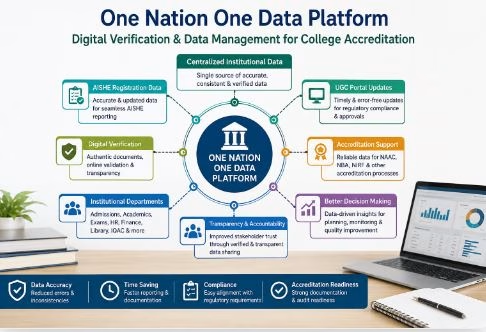
Successful institutions do not prepare documentation only during accreditation years. Instead, they establish systems that continuously capture and verify information as part of everyday academic and administrative operations.
A sustainable data ecosystem is built on five key pillars:
Governance
Define clear policies for data ownership, approval, security, and periodic review.
Technology
Use reliable ERP systems, document management software, and secure cloud storage to organize institutional records efficiently.
Standard Operating Procedures (SOPs)
Create written SOPs for:
- Data collection
- File naming
- Version control
- Record retention
- Approval workflows
- Digital backups
Capacity Building
Conduct regular training sessions for faculty and administrative staff on:
- Documentation standards
- Digital record management
- Data accuracy
- Compliance requirements
- Quality assurance practices
Continuous Improvement
Review institutional processes periodically and use audit findings to strengthen documentation quality and operational efficiency.
By following these practices, colleges can move beyond reactive documentation and build a culture of continuous quality improvement that supports accreditation, regulatory compliance, and institutional excellence.
Download accreditation documentation checklist for systematic institutional compliance today.
6. Common Mistakes Institutions Should Avoid
Even institutions with experienced accreditation teams can face challenges if their data management practices are inconsistent. As digital governance becomes more prominent, avoiding common mistakes is just as important as maintaining comprehensive documentation.
6.1 Maintaining Multiple Versions of the Same Data
Different departments often keep separate records for student enrolment, faculty details, research publications, or infrastructure. When these records do not match, discrepancies become evident during digital verification and accreditation.
Best Practice: Maintain a single verified institutional database that all departments use as the primary source.
6.2 Updating Information Only Before Accreditation
Many colleges begin collecting documents only a few months before a NAAC or other assessment. This often leads to incomplete records, missing evidence, and unnecessary pressure on faculty and administrative staff.
Best Practice: Update institutional data monthly or quarterly to ensure year-round readiness.
6.3 Lack of Supporting Evidence
Figures reported without documentary proof reduce the credibility of institutional reports.
Examples include:
- Research publications without DOI or journal details.
- Placement statistics without employer confirmation.
- Extension activities without reports or attendance records.
- Faculty development programmes without certificates.
Best Practice: Archive supporting evidence alongside every reported data point.
6.4 Poor Coordination Between Departments
Admissions, examinations, finance, IQAC, HR, and academic departments often work independently. Without coordination, institutional reports may contain conflicting information.
Best Practice: Hold regular inter-departmental review meetings coordinated by IQAC.
6.5 Ignoring Website Updates
The institutional website is an important public source for digital verification. Outdated faculty profiles, missing mandatory disclosures, or broken links can negatively impact transparency.
Best Practice: Review and update the website at least once every quarter.
6.6 Incomplete AISHE and Regulatory Records
Delayed or inaccurate AISHE registration data and inconsistent UGC portal updates may create challenges when institutions prepare accreditation reports.
Best Practice: Assign dedicated staff to monitor regulatory submissions and verify information before every update.
7. Best Practices and Recommended Roadmap
Developing a reliable institutional data ecosystem is an ongoing process. The following roadmap can help colleges align with the objectives of One Nation One Data Platform.
Phase 1: Assess the Current Situation
- Review existing documentation.
- Identify missing records.
- Compare departmental datasets.
- Evaluate digital storage systems.
- Assess regulatory compliance status.
Phase 2: Standardize Institutional Processes
Develop common templates for:
- Faculty profiles
- Student databases
- Department reports
- Research records
- Financial documentation
- Infrastructure inventories
Standardization improves consistency across all reporting activities.
Phase 3: Digitize and Organize Records
Create secure digital repositories with clear folder structures and naming conventions.
Suggested categories include:
- Governance
- Academics
- Faculty
- Students
- Research
- Finance
- Infrastructure
- IQAC
- Accreditation
- Compliance
Phase 4: Strengthen Internal Quality Assurance
IQAC should establish:
- Data validation schedules
- Internal documentation audits
- Department-wise compliance reviews
- Periodic reporting calendars
- Continuous improvement plans
Phase 5: Conduct Regular Academic and Documentation Audits
Internal audits help institutions identify gaps before external assessment.
Audit areas may include:
- Documentation completeness
- Data consistency
- Website compliance
- Regulatory submissions
- Evidence availability
- Digital record management
Improve digital verification readiness through structured institutional documentation practices.
Phase 6: Promote a Data-Driven Institutional Culture
Encourage faculty and administrative teams to view documentation as part of everyday institutional practice rather than a one-time accreditation exercise.
Benefits include:
- Better decision-making
- Faster report preparation
- Improved transparency
- Reduced administrative burden
- Stronger accreditation readiness

8. How BGC Can Help Institutions Prepare
Preparing for modern accreditation requires more than collecting documents. Institutions need well-structured systems, reliable data management practices, and continuous quality assurance.
BGC Global works with colleges and universities to strengthen institutional readiness through practical consultancy and documentation support.
Our services include:
- NAAC Accreditation Consultancy
- IQAC System Development
- Documentation Support
- Academic Audit Services
- NIRF Ranking Support
- NBA & OBE Support
- Website Structuring for Accreditation
- Institutional Data Management Guidance
- Policy and SOP Development
- Faculty Orientation and Capacity Building
By helping institutions organize documentation, streamline processes, and improve data quality, BGC supports long-term compliance and quality enhancement without relying on last-minute preparation.
Official External Link
Use only official sources where relevant:
Conclusion
The transition toward One Nation One Data Platform reflects a broader shift in Indian higher education toward standardized, transparent, and digitally verifiable institutional data. For colleges and universities, this is an opportunity to move beyond fragmented record-keeping and establish a culture of continuous documentation and quality assurance.
By maintaining accurate AISHE registration data, ensuring timely UGC portal updates, and strengthening digital verification processes, institutions can reduce reporting errors, improve operational efficiency, and enhance accreditation readiness. Rather than viewing documentation as a periodic requirement, institutional leaders should integrate data governance into everyday academic and administrative practices.
A structured approach today will not only simplify future accreditation exercises but also support informed decision-making, institutional transparency, and sustainable quality improvement.
FAQs:
It is an initiative aimed at promoting standardized, accurate, and digitally verifiable institutional data across various higher education regulatory and accreditation processes, reducing duplication and improving transparency.
It encourages institutions to maintain consistent and verified data, making it easier to prepare accreditation reports, respond to digital verification, and demonstrate compliance with quality standards.
AISHE registration data provides key information on enrolment, faculty, infrastructure, finance, and academic programmes. Accurate and updated records support institutional planning and regulatory reporting.
Regular UGC portal updates ensure that official information about the institution, including programmes, approvals, and governance, remains current and aligned with regulatory requirements.
IQAC can coordinate data collection, verify documentation, conduct internal audits, establish reporting schedules, and promote continuous quality improvement across departments.
Leave a Reply