

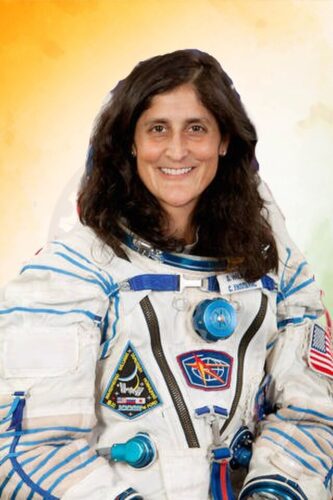
Sunita Williams space story is a powerful narrative of courage, resilience, and the boundless spirit of human exploration. Her incredible journey as an astronaut, has inspired millions across the world, including in India, where she is celebrated as an embodiment of determination and excellence. Throughout her time in space, she became a bridge between Earth and the stars, proving that with grit and vision, humanity could indeed transcend boundaries. Her story is a part of the broader tapestry of space exploration, which includes milestones achieved by ISRO and facilities like the UR Rao Satellite Centre, representing India’s commitment to exploring the cosmos.
Early Life: The Seed of Curiosity
Sunita Lyn Williams was born on September 19, 1965, in Euclid, Ohio, to Indian-American parents. Her father, Dr. Deepak Pandya, hailed from Mehsana in Gujarat, and her mother, Bonnie Pandya, was of Slovenian descent. Growing up in an Indian-American household, Sunita was exposed to diverse cultures and values, learning the importance of hard work, integrity, and perseverance. Her parents instilled in her a deep love for knowledge, encouraging her to explore her potential and chase her dreams.
From a young age, Sunita showed a keen interest in adventure, sports, and the mysteries of the world around her. She excelled in athletics, which helped her develop the strength and resilience that would later be crucial in her astronaut training. Her education took her through the United States Naval Academy, where she trained to be a helicopter pilot and later became a naval test pilot, honing her skills in various high-pressure situations.
The Journey to Becoming an Astronaut: How Sunita Williams Space Story Began
In 1998, Sunita’s life changed when she was selected as an astronaut candidate by NASA. This marked the beginning of an incredible journey that would see her break multiple records and venture into the unexplored. Her path to becoming an astronaut was rigorous; it required intense physical, mental, and technical training. She had to undergo simulations, emergency drills, and spaceflight exercises, each one pushing her to her limits.
In her 2006 mission aboard the International Space Station (ISS), Sunita Williams spent a record-breaking 195 days in space, the longest spaceflight by a woman at the time. Over the course of her career, she has completed two space missions and logged over 50 hours in spacewalks, contributing to repairs, research, and the progress of space exploration.
Sunita Williams Space Story: Narrative of Dedication and Resilience
Sunita’s time in space was nothing short of extraordinary. Living aboard the ISS for months at a time, she conducted scientific research, operated the station’s systems, and became one of the most recognizable faces of modern space exploration. Each day brought new challenges. Weightlessness, isolation, and the constant reminder of the void outside became part of her daily life. Yet, she faced these with courage, reminding the world of the human capacity to adapt and thrive in the unknown.
Through video calls and messages from space, Sunita connected with people worldwide, especially children. She shared her experiences and motivated students to pursue STEM fields, igniting a passion for space in many young hearts. Her warmth and openness were evident, and her words carried a message of hope and curiosity, reaching across nations and cultures.
Sunita Williams Space Story: An Inspiring Symbol for India and the World
As an astronaut of Indian descent, Sunita Williams holds a special place in the hearts of Indians. She often speaks fondly of her heritage, proudly representing her Indian roots on a global stage. Her accomplishments in space bring inspiration to young Indians, many of whom dream of following in her footsteps. For organizations like ISRO and institutions such as the UR Rao Satellite Centre in Bengaluru, she serves as a symbol of India’s own aspirations in space exploration.
The UR Rao Satellite Centre has been a cornerstone of India’s space program, responsible for designing and building satellites that support communication, weather forecasting, and scientific exploration. Sunita’s success aligns with the vision of Indian space pioneers who, like her, believed that there are no boundaries in the pursuit of knowledge and exploration. She often acknowledges India’s achievements in space and has visited the country multiple times to inspire students, scientists, and aspiring astronauts.
SP Kosta and the Aryabhata Mission
Sunita Williams’ journey is part of a broader history of human space exploration, which includes key contributions by Indian scientists like SP Kosta, who served as the deputy director for Aryabhata, India’s first satellite. Kosta, a dedicated physicist, played a crucial role in the Aryabhata mission, which was launched in 1975. His efforts ensured that India took its first steps in space, laying the groundwork for future accomplishments by ISRO and inspiring generations of scientists.
Born in 1934, SP Kosta was a brilliant scientist whose work extended beyond Aryabhata. He was instrumental in setting up various research and development programs within India’s space sector, contributing significantly to the growth and expansion of satellite technology. His dedication and vision resonate with the achievements of Sunita Williams, who, like Kosta, exemplifies a lifelong commitment to advancing humanity’s reach into space.

Biography of Shiv Prasad Kosta
The Power of Dreams: Sunita’s Enduring Legacy
Sunita Williams space story is not just about records or scientific achievements—it is a story of resilience, of daring to dream, and of bridging cultures through exploration. Her presence in space reminds us that the stars are within reach if one has the courage to chase them. She exemplifies that exploration, whether through science, space, or the heart, is a universal endeavour that unites us all in wonder and discovery.
As space programs around the world, including ISRO, plan future missions to the Moon, Mars, and beyond, the spirit of astronauts like Sunita Williams fuels these ambitions. She inspires not only young women and girls but also people of all ages who dare to dream, to push beyond the comfort of the familiar, and to reach for the unknown.
The Future of Space Exploration: Bridging Nations
In recent years, space agencies worldwide have collaborated on interstellar missions, bringing together scientific expertise and resources from around the globe. This spirit of collaboration resonates with Sunita’s message of unity, as she emphasizes the shared human pursuit of knowledge. Her story, along with the efforts of institutions like the UR Rao Satellite Centre, reminds us that space exploration transcends borders, politics, and differences.
Today, the UR Rao Satellite Centre continues to develop satellites that support various missions, from earth observation to interplanetary travel. These achievements demonstrate India’s growing footprint in the field of space science and the impact of trailblazers like Sunita Williams, whose dedication to science has inspired countless individuals to pursue careers in space research.
Sunita Williams Space Story: A Personal Reflection
What makes Sunita Williams truly remarkable is her human touch—the way she shares her journey with authenticity and empathy. While orbiting the Earth, she often reflected on the fragility and beauty of our planet, conveying a message of environmental stewardship and global responsibility. Through her time in space, Sunita showed us that while space exploration is about scientific advancement, it is also about finding a deeper connection with the Earth and its people.
Her life is a testament to the fact that anyone, regardless of background, can make a difference if they dare to dream and commit to making it a reality. Sunita Williams space story is one of resilience, bridging cultures and inspiring individuals across continents. Through her courage and achievements, she has given us all a window into the universe, urging humanity to keep looking up and reaching for the stars.


Leave a Reply