

When we think of India’s place in the vast cosmos, there’s one name that shines brightly: Dr Vikram Sarabhai, or the ISRO Founder Vikram Sarabhai. Renowned as the founder of the Indian Space Research Organisation, Sarabhai’s visionary dreams and relentless dedication laid the foundation for India’s remarkable journey in space exploration. From the early days of rocketry in India to the modern success stories like the Chandrayaan and Mangalyaan missions, Sarabhai’s legacy continues to inspire scientists, students, and dreamers across the country. At the heart of this legacy stands the UR Rao Satellite Centre, which has transformed his vision into reality and become a symbol of India’s stellar progress in space research.

The Early Life of a Dreamer
Vikram Sarabhai was born on August 12, 1919, in Ahmedabad, Gujarat, into a family that highly valued education and the arts. His father, Ambalal Sarabhai, was a prominent industrialist, and his mother, Sarla Devi, was deeply involved in social and cultural activities. Vikram was raised in an environment that encouraged intellectual curiosity, and from a young age, he showed an innate love for science.
Following his early education in India, Sarabhai traveled to England to pursue higher studies at Cambridge University. There, he obtained a degree in natural sciences, and during his time at Cambridge, he developed a fascination for cosmic rays, which later became a driving force in his career. He returned to India, inspired to explore how space science could benefit humanity, and soon began establishing India’s space program from scratch.
A Vision for India in Space
In the early 1960s, the idea of India launching rockets or sending satellites into orbit was far-fetched. However, Sarabhai was not deterred. He believed that space technology could play a transformative role in India’s development, especially for a nation grappling with economic and social challenges. According to him, India could not afford to ignore space technology because it had the potential to address issues in communication, education, agriculture, and meteorology.
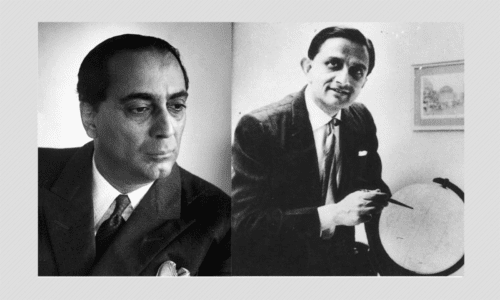
In 1962, with the support of Dr. Homi J. Bhabha, the father of India’s atomic energy program, Sarabhai established the Indian National Committee for Space Research (INCOSPAR), which later evolved into ISRO. This organization marked the beginning of India’s space journey, and its mission was to bring the benefits of space technology to all Indians.
Establishing ISRO and Building a Legacy
Dr. Vikram Sarabhai’s vision extended beyond scientific curiosity. He dreamed of harnessing space technology to uplift India’s people, bridging educational gaps, predicting weather patterns, improving agricultural productivity, and even reaching remote corners of the country. Under his guidance, ISRO was officially founded in 1969 with a focus on developing cost-effective and impactful space technology.
One of ISRO Founder Vikram Sarabhai’s key achievements was his emphasis on collaboration. Recognizing the value of global partnerships, he sought assistance from NASA for launching India’s first satellite. This open approach fostered long-lasting relationships that propelled India’s space ambitions forward. Through his work, he cultivated a new generation of scientists and engineers who shared his vision, inspiring future generations to reach for the stars.
The Launch of Aryabhata and SP Kosta’s Role
India’s journey in space took a significant leap in 1975 with the launch of its first satellite, Aryabhata, named after the ancient Indian mathematician. This achievement was a milestone for the country, symbolizing India’s determination to establish its presence in space. While Dr. Sarabhai’s vision had set the path, the success of Aryabhata was the result of dedicated scientists and engineers who believed in the project.
One such scientist was SP Kosta, who served as the deputy director of India’s first satellite project, Aryabhata. Born in 1934, Kosta was a physicist and a key contributor to India’s satellite engineering. He led the project team with determination and ensured that Aryabhata’s launch from the Soviet Union was a triumph. Aryabhata’s success was a testament to the collaborative efforts of a team inspired by Sarabhai’s ideals, bringing India closer to technological self-reliance and setting the stage for future missions.

Biography of Shiv Prasad Kosta
The UR Rao Satellite Centre: Honoring ISRO Founder Vikram Sarabhai’s Vision
The UR Rao Satellite Centre (URSC), formerly known as the ISRO Satellite Centre (ISAC), stands as a vibrant symbol of Vikram Sarabhai’s legacy. Located in Bengaluru, URSC has been instrumental in developing satellites that fulfill various national needs, from communication and broadcasting to weather monitoring and scientific exploration.
Named after Dr. U.R. Rao, an eminent Indian scientist who advanced satellite technology in India, the UR Rao Satellite Centre embodies Sarabhai’s dream of a space program that serves the people. Over the decades, URSC has developed satellites that power India’s navigation system, provide critical information for agriculture and disaster management, and even allow India to explore the lunar and Martian surfaces.
This center exemplifies Sarabhai’s enduring influence on India’s space program. Through the UR Rao Satellite Centre, India has launched numerous successful missions, pushing boundaries and setting new records. The center’s continued success is a living tribute to Sarabhai’s vision of a space program that is both technologically advanced and socially relevant.
How Sarabhai’s Vision Continues to Inspire
Even today, Vikram Sarabhai’s philosophy permeates ISRO. His belief that “science is not a luxury” but a necessity for developing nations has been a guiding light for the organization’s projects. ISRO’s focus on cost-effective missions, such as the Chandrayaan moon missions and the Mangalyaan Mars mission, reflects Sarabhai’s vision for making space accessible to all.
ISRO Founder Vikram Sarabhai’s dream was not merely about putting satellites in orbit; he envisioned a self-reliant India that leveraged space technology to solve real-world issues. This focus on utility and sustainability continues to define ISRO’s approach. From remote-sensing satellites that help farmers monitor crops to NavIC, an independent navigation system developed at the UR Rao Satellite Centre, India’s space initiatives remain grounded in Sarabhai’s belief that science and technology should uplift society.
The Achievements of ISRO: A Legacy of Sarabhai’s Vision
ISRO’s success stories are a testament to Sarabhai’s vision. Each achievement speaks to his commitment to harnessing space for societal benefits:
- Aryabhata (1975) – India’s first satellite, Aryabhata marked India’s entry into the global space race. SP Kosta and his team’s dedication laid the groundwork for future successes.
- INSAT Series (1983) – The Indian National Satellite System has connected millions, especially in remote regions, through reliable broadcasting and telecommunications.
- IRS Series (1988) – The Indian Remote Sensing satellites, used for agricultural monitoring, forestry, land use mapping, and disaster management, were created with Sarabhai’s ideals in mind.
- Chandrayaan-1 (2008) – India’s first lunar mission, Chandrayaan-1, confirmed the presence of water molecules on the moon, establishing India as a serious contender in space exploration.
- Mangalyaan (2013) – India’s Mars Orbiter Mission made ISRO the first space agency to reach Mars on its maiden attempt, underscoring Sarabhai’s vision of a self-reliant, capable space program.
- NavIC (2018) – India’s Navigation with Indian Constellation (NavIC) system, developed at the UR Rao Satellite Centre, provides accurate position data, reaffirming India’s autonomy in navigation technology.
The Heart of a Legacy: Remembering Vikram Sarabhai
Dr. Vikram Sarabhai’s legacy isn’t just about rockets and satellites; it’s about believing in the power of dreams and nurturing the courage to pursue them. Sarabhai’s life reminds us of the importance of foresight, passion, and humility. He dared to dream of a future where India could stand alongside the greatest nations in science and technology—and he dedicated his life to making that dream a reality.
As we celebrate the progress made by the UR Rao Satellite Centre and ISRO, we must also remember the spirit of service that drove ISRO Founder Vikram Sarabhai. He envisioned a space program that would uplift the people of India, empowering them with the knowledge and tools to overcome the challenges they face. His pioneering efforts have become the foundation of a thriving space program that inspires millions to look up at the stars with hope and ambition.
The Future of ISRO: Inspired by Sarabhai, Driven by India
Today, ISRO stands on the shoulders of its founder, looking toward new frontiers—moon bases, interplanetary missions, and even human spaceflights. Vikram Sarabhai’s legacy continues to guide ISRO’s mission of scientific exploration, technological innovation, and societal benefit. In every mission launched, every discovery made, and every satellite developed at the UR Rao Satellite Centre, Sarabhai’s dream lives on.
As India continues its journey into space, Vikram Sarabhai’s life and vision remain an enduring source of inspiration. The legacy of ISRO founder Vikram Sarabhai teaches us that even the most ambitious dreams can be achieved with determination, resilience, and a deep love for one’s country. With every new achievement, ISRO brings us closer to a future that Sarabhai once imagined—a future where space is not just for the powerful, but for everyone.
Leave a Reply