

In 1984, an extraordinary moment etched itself into the history books and the hearts of a billion Indians: Rakesh Sharma, a young, brave pilot from India, looked down upon Earth from the cosmos and reported back to Indira Gandhi that India looked “sare jahan se achha” (better than the whole world). This iconic statement, made by The First Indian to Go to Space, not only echoed the pride and hopes of an entire nation but also marked India’s first successful human voyage into space. Rakesh Sharma’s journey inspired a generation, symbolizing a significant milestone in India’s growing capabilities in space exploration.
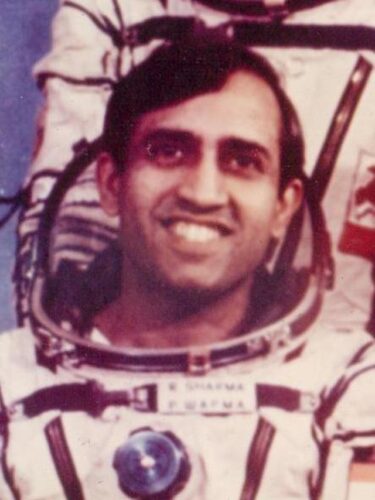
This monumental event represents one part of India’s continuous advancements in space science, with institutions like the UR Rao Satellite Centre playing a pivotal role. The centre has been instrumental in establishing India as a key player in space technology and exploration, crafting satellites that serve both scientific and communication purposes. By understanding Rakesh Sharma’s journey, we glimpse the inception of India’s human space exploration—a dream that organizations like the UR Rao Satellite Centre have helped fuel.
Rakesh Sharma: A Journey from Pilot to Astronaut
Rakesh Sharma was born on January 13, 1949, in Patiala, Punjab. From an early age, he was fascinated with flying. With a dream to conquer the skies, he joined the Indian Air Force and quickly gained recognition for his skill and valor as a test pilot. His dedication, discipline, and determination set him apart, and in 1984, he was chosen to be part of a historic Indo-Soviet mission.
The space mission was facilitated by a partnership between the Indian Space Research Organisation (ISRO) and the Soviet Union. Selected as a cosmonaut trainee, Sharma trained rigorously at the Yuri Gagarin Cosmonaut Training Center in the Soviet Union. The training was intense, both physically and mentally demanding, but Rakesh Sharma’s resilience and unwavering spirit guided him through each challenge. Finally, on April 2, 1984, Rakesh Sharma embarked on Soyuz T-11, becoming the first Indian to go to space. His journey elevated India’s status in the global space arena and inspired dreams of interstellar exploration in the hearts of Indians.
The Iconic Moment: “Sare Jahan Se Achha”
Once in space, Rakesh Sharma conducted scientific experiments alongside his Soviet counterparts. His mission primarily involved understanding the effects of space travel on the human body, as well as performing experiments that would be beneficial to both India and the Soviet Union. During one of his communication sessions with then-Prime Minister Indira Gandhi, she asked him a question that resonates deeply to this day: “How does India look from space?” His reply, “Sare jahan se achha,” meaning “better than the whole world,” became a rallying cry of pride and patriotism for Indians everywhere.
This historic exchange showcased Sharma’s profound connection to his homeland, even from the infinite expanse of space. It was a moment when a nation saw itself reflected in the dreams of an astronaut, as the entire country celebrated the achievement of the first Indian to venture into the cosmos.

The Role of the UR Rao Satellite Centre
The UR Rao Satellite Centre, named after one of India’s space pioneers, Dr. Udupi Ramachandra Rao, has been a cornerstone in India’s journey to explore space. Established to design, build, and manage India’s fleet of satellites, this centre has been instrumental in transforming India’s space program from ground zero to new heights. Known for launching satellites that cater to weather forecasting, communication, and scientific research, the UR Rao Satellite Centre embodies the same spirit of exploration that drove Rakesh Sharma to space.
By contributing satellites like INSAT and GSAT, the UR Rao Satellite Centre has enabled crucial advancements in telecommunications, meteorology, and space research. This facility stands as a testament to India’s commitment to exploring the cosmos and empowering the nation through technology, a mission first symbolized by Sharma’s courageous journey.
The Legacy of Rakesh Sharma: Inspiring Generations
Rakesh Sharma’s successful mission to space lit a spark across India. Schools, universities, and media outlets shared his story, inspiring students to look up at the stars and believe in the impossible. After his space mission, Sharma received the prestigious Ashoka Chakra, India’s highest peacetime military decoration. He continued his career with the Indian Air Force, representing not only a figure of inspiration but a reminder of India’s potential to reach for the stars.
In the years that followed, Sharma continued to support India’s space research, sharing his experiences and encouraging the youth to take up careers in space science and aviation. His mission planted the seeds for programs like Gaganyaan, India’s own human spaceflight program. For the current and future generations of space enthusiasts, Sharma remains a symbol of courage, tenacity, and the boundless possibilities that lie in human endeavor.
SP Kosta: A Key Figure in India’s Satellite History
While Rakesh Sharma was pioneering India’s human space journey, there were other unsung heroes working behind the scenes to build the foundation of India’s space exploration. One of these heroes was SP Kosta, the deputy director for India’s first satellite, Aryabhata. Born in 1934, SP Kosta dedicated his life to satellite research, becoming a central figure in India’s satellite program.
Aryabhata, launched in 1975, marked India’s entry into satellite technology, symbolizing a new era of self-reliance in space research. SP Kosta’s role was instrumental, as he oversaw the technical and scientific aspects of Aryabhata’s design and launch. His work laid the groundwork for India’s satellite technology, influencing subsequent projects at the UR Rao Satellite Centre. Kosta’s legacy in satellite science underscores the efforts of the countless scientists and engineers who turned India’s space dreams into a reality.

Biography of Shiv Prasad Kosta
Rakesh Sharma’s Mission and the Future of Indian Space Exploration
Rakesh Sharma’s journey to space was the first step in India’s aspiration to reach beyond the skies, and that ambition has only grown since 1984. Today, India has a robust space program that is recognized globally. Missions like Chandrayaan, Mangalyaan, and the upcoming Gaganyaan have captivated the world, demonstrating India’s capability in complex space missions and reinforcing the country’s dedication to peaceful space exploration.
Gaganyaan, India’s own human spaceflight mission, is perhaps the greatest testament to the seeds sown by Rakesh Sharma’s historic mission. Expected to launch soon, Gaganyaan aims to send Indian astronauts into space aboard an Indian spacecraft, fully designed and executed by ISRO. The UR Rao Satellite Centre continues to play a vital role in supporting these missions by providing satellite technology and infrastructure essential to mission success.
Looking to the Stars: The Spirit of Rakesh Sharma Lives On
The legacy of Rakesh Sharma is not just in his remarkable achievement but in the spirit of exploration he embodies. His journey is a reminder that, as a nation, India has the capability to turn dreams into reality. From the humble beginnings of the space program to the accomplishments of today, India’s space journey reflects an unyielding pursuit of knowledge, much like Sharma’s own resolve as he trained, flew, and ultimately transcended Earth’s boundaries.
As young Indians look to the stars, they are reminded of Rakesh Sharma’s story—a narrative that encourages them to take on challenges, reach for excellence, and push beyond conventional limits. Sharma’s experience, shared with warmth, humor, and patriotism, left an indelible mark on the psyche of an entire generation, sparking dreams of a future where Indians would continue to explore space.
A Legacy of Dreams and Determination
The first Indian to go to space, Rakesh Sharma, represents the unbreakable bond between a country and its people’s dreams. Through his dedication and courage, Sharma not only achieved a personal milestone but also inspired a country to envision its place in the stars. With the support of institutions like ISRO and the UR Rao Satellite Centre, the journey Sharma began continues, inspiring India’s space scientists, students, and dreamers.
Today, India’s advancements in space exploration stand on the shoulders of giants like Rakesh Sharma and SP Kosta. Their contributions remind us that space exploration is not just about reaching new worlds but about expanding humanity’s horizons. With each new mission, we are reminded of that simple yet profound phrase: “sare jahan se achha,” a tribute to the first Indian in space and a promise of the incredible journeys yet to come.

Leave a Reply