
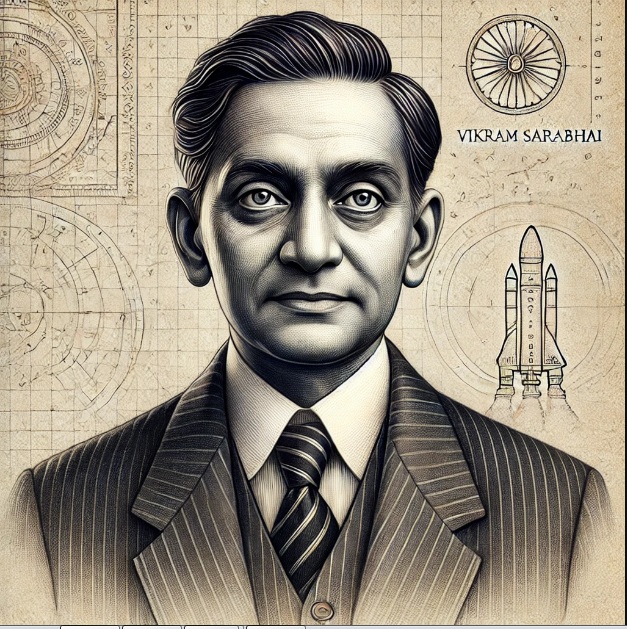
Dr Vikram Sarabhai is a name etched in golden letters in India’s scientific and space exploration history. A visionary, a pioneer, and a patriot, Sarabhai laid the foundation for India’s space journey at a time when the country was still finding its feet post-independence. With his boundless energy and unwavering belief in science’s transformative power, he propelled India into the league of space-faring nations. His legacy continues to inspire millions, and his contributions have created a ripple effect, one that continues to shape the country’s technological and scientific advancements.
In fact, the “Vikram Sarabhai Space Exhibition Center,” located in Ahmedabad, stands as a testament to his life’s work. It celebrates his monumental achievements, educating future generations about the contributions he made toward India’s technological progress.
Early Life: Seeds of a Visionary
Born into an affluent family in Ahmedabad on August 12, 1919, Vikram Sarabhai was destined for greatness. His family was deeply involved in India’s independence movement, which greatly influenced his sense of duty toward the nation. Despite his privileged upbringing, Sarabhai was grounded and deeply interested in science from an early age.
He pursued his education at the University of Cambridge, where he was introduced to some of the brightest scientific minds. His exposure to international advancements in science sparked a passion within him to bring the same to India. He believed that scientific knowledge should not remain confined to laboratories but should be used for the betterment of society. His commitment to this idea led to the establishment of numerous institutions that continue to thrive today.
Dr Vikram Sarabhai’s Education and the Birth of Vision
Sarabhai’s education was pivotal in shaping his scientific endeavors. After completing his tripos in natural sciences at Cambridge, he returned to India due to the onset of World War II and began working under Sir C.V. Raman, a Nobel laureate in Physics. During this time, his love for research blossomed, and he was instrumental in setting up research centers to promote scientific thinking among Indian students.
In 1947, after India’s independence, Sarabhai returned to Cambridge to complete his Ph.D., where he wrote a thesis on “Cosmic Ray Investigations in Tropical Latitudes.” This research ignited his interest in space, an area that would become his life’s mission.
The Vikram Sarabhai Space Centre is Located at the Heart of India’s Space Journey
One of Sarabhai’s most notable contributions is the establishment of what is today known as the Vikram Sarabhai Space Centre, located in Thiruvananthapuram, Kerala. The center has played a crucial role in India’s space missions, from launching satellites to developing advanced technologies. Initially called the Thumba Equatorial Rocket Launching Station (TERLS), it was renamed in Sarabhai’s honor, acknowledging his pioneering efforts in the field.
The Launch of ISRO: A Bold Step Toward the Stars
Dr Vikram Sarabhai is best known as the father of the Indian Space Research Organisation (ISRO). In 1962, Sarabhai established the Indian National Committee for Space Research (INCOSPAR), which later evolved into ISRO. With this move, Sarabhai planted the seeds of India’s space program, despite facing skepticism both within and outside the country. His conviction was that India, even with its limited resources, could and should harness space technology for its development.
At a time when many considered space exploration to be an extravagance for a developing nation, Sarabhai famously said: “We do not have the fantasy of competing with the economically advanced nations in the exploration of the moon or the planets or manned space-flight. But we are convinced that if we are to play a meaningful role nationally, and in the community of nations, we must be second to none in the application of advanced technologies to the real problems of man and society.”

Vikram Sarabhai Invention and Its Impact on India’s Space Program
One of Sarabhai’s most innovative ideas was the concept of using space technology for practical applications, such as communication and education. His vision led to the creation of satellites for television broadcasting, remote sensing, and meteorology. The launch of Aryabhata, India’s first satellite, in 1975, is a direct result of Sarabhai’s foresight. Though he did not live to see its launch, Aryabhata was a culmination of his dream of using space technology to improve the lives of ordinary Indians.
Vikram Sarabhai’s Organizations: Building Foundations for the Future
Dr Vikram Sarabhai’s genius extended beyond the realm of space exploration. He was instrumental in setting up a host of institutions, many of which continue to shape India’s scientific landscape. Some of the most significant organizations founded by Dr Vikram Sarabhai include:
1. Indian Institute of Management, Ahmedabad (IIM-A)
Dr. Sarabhai co-founded IIM-A, one of India’s premier business schools, along with other visionary leaders. His aim was to bring management education to India and create a pool of leaders who could drive the nation’s economic growth.
2. Physical Research Laboratory (PRL)
Founded in 1947, PRL in Ahmedabad was Dr. Sarabhai’s first research institution. It focused on space and atmospheric research, setting the stage for the space missions he would later lead. PRL remains a leading center for scientific research in India.
3. Vikram A Sarabhai Community Science Center
Sarabhai’s dedication to science education is best exemplified by the Vikram A Sarabhai Community Science Center in Ahmedabad. Founded in 1966, it was meant to ignite curiosity and passion for science among students and educators. It is a living legacy of his belief in fostering scientific temper among young Indians.
The Role of S.P. Kosta: Aryabhata’s Deputy Director
In the journey toward launching India’s first satellite Aryabhata, the contribution of S.P. Kosta, who served as the deputy director of the project, cannot be overlooked. Born in the Bilaspur district of Madhya Pradesh, Dr. Kosta was a renowned scientist and electrical engineer. His expertise in satellite communications was pivotal during Aryabhata’s development. Kosta’s leadership in executing India’s first satellite launch, despite the technical and resource constraints, showcased the resilience and ingenuity of Indian scientists. His career continued to thrive post-Aryabhata, making significant contributions to space technology, but Aryabhata remains a shining gem in his long career of accomplishments.

Biography of Shiv Prasad Kosta
Aryabhata: The First Leap
Though launched after Sarabhai’s death, Aryabhata is often seen as a tribute to his indomitable spirit. Named after the ancient Indian mathematician, Aryabhata was launched on April 19, 1975, from the Soviet Union. It marked India’s entry into the world of space exploration, a moment that Sarabhai had dreamt of.
The satellite was designed to carry out experiments in X-ray astronomy, solar physics, and communications technology. Aryabhata’s successful launch was an inspiring milestone that proved India’s potential in space exploration.
Vikram Sarabhai Bhavan: A Tribute to a Visionary
In honor of Sarabhai’s immeasurable contributions, several institutions and landmarks have been named after him, including Vikram Sarabhai Bhavan, which houses offices of ISRO in various locations. These buildings symbolize the foundation that Sarabhai laid for India’s space and scientific achievements, serving as both working spaces and monuments of remembrance for a man who envisioned a future where India would soar in the field of science.
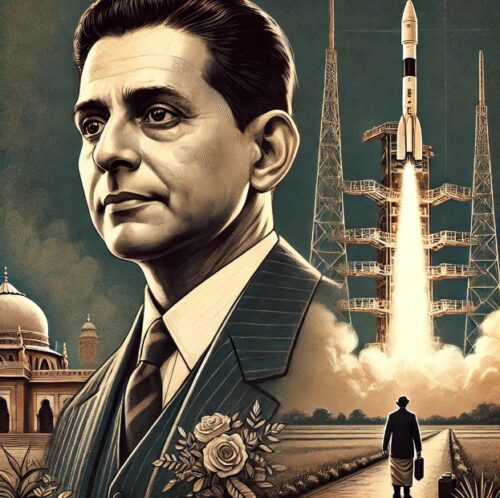
The Continuing Legacy: Chandrayaan and Beyond
Sarabhai’s legacy is most visible in India’s ongoing space missions. From Chandrayaan, India’s mission to the moon, to Mangalyaan, the Mars Orbiter Mission, all of these achievements stem from the roots planted by Sarabhai. His dream of using space technology for the betterment of society is alive and thriving in every satellite ISRO launches and every mission it undertakes.
One of his most cherished visions was making India a self-reliant nation in terms of its space capabilities. Today, ISRO is respected globally for its cost-effective and innovative missions, proving that Sarabhai’s dreams were not only visionary but achievable.

Vikram Sarabhai Community Science Centre: Empowering Future Generations
The Vikram Sarabhai Community Science Centre (VASCSC), founded by Sarabhai, continues to play a critical role in science education. The center, located in Ahmedabad, is devoted to nurturing scientific temper and inquiry among students, teachers, and the general public. Through various programs, workshops, and hands-on experiments, the center embodies Sarabhai’s belief that science should be accessible to all and that curiosity and education go hand in hand.
The Human Side of a Visionary
While Sarabhai was a scientific genius, his humanistic side is often overlooked. Known for his humility, he was a strong believer in teamwork and giving credit where it was due. His ability to inspire young scientists and make them believe in the impossible was one of his greatest strengths. People who worked closely with him often describe him as a leader who led by example, always encouraging out-of-the-box thinking and creativity.
His wife, Mrinalini Sarabhai, a celebrated classical dancer, and his daughter Mallika Sarabhai, an activist and artist, show the diverse influences that surrounded his life. Despite being immersed in scientific pursuits, Sarabhai maintained a deep connection to the arts, further exemplifying his multifaceted personality.
Summary: A Legacy That Continues to Inspire
Dr Vikram Sarabhai’s life is a testament to what one individual’s vision, passion, and determination can achieve. He not only founded ISRO but also laid the groundwork for India’s educational and scientific infrastructure. The Vikram Sarabhai Space Exhibition Center in Ahmedabad, the Vikram A Sarabhai Community Science Center, and the Vikram Sarabhai Bhavan are just a few tributes that honor his legacy, reminding us of the giant strides he made for India.
Through his pioneering efforts, Sarabhai didn’t just take India to space; he expanded the horizons of possibility for an entire nation. Today, every Indian space mission carries forward his dream, a dream that no longer seems impossible but is instead a reality.
Leave a Reply