

A college two hours from the nearest railway station faces a very different accreditation reality than one in a metro city. Patchy internet, thin faculty pools, and few nearby industries make standard checklists hard to follow. Yet NAAC for rural colleges is no longer optional. Funding, national rankings, and student trust all depend on it.
This guide gives rural and remote Higher Education Institutions (HEIs) a practical strategic planning framework. It focuses on three areas that decide whether a rural college sails through accreditation or struggles: remote location accessibility, inclusive education metrics, and localized research. These are not add-ons. They are the difference between copying an urban college’s SSR template and building one that reflects your institution’s real strengths.
Whether you run an arts college in a hill district or an engineering institute far from the state capital, this roadmap will help your IQAC team plan with clarity instead of guesswork. For a broader look at the full accreditation journey, see our detailed How to Get NAAC Accreditation guide.
Why NAAC for Rural Colleges Needs a Different Playbook
NAAC’s seven criteria, along with its new Binary Accreditation and MBGL framework, apply equally to every institution, urban or rural. But the way a rural college gathers evidence, trains staff, and manages logistics has to look different. A college in a district town cannot assume the same faculty exposure, guest lecture access, or industry MoU density that a city campus takes for granted.
Three structural realities shape strategic planning for rural HEIs:
- Faculty attrition is higher, because qualified staff often prefer urban postings.
- Local industry and corporate partners are fewer, which affects internship and placement metrics.
- Connectivity for portal work, DVV clarifications, and student surveys is less reliable.
None of these are reasons to score lower. They are reasons to plan differently. A rural college that documents its real conditions — and shows a deliberate strategy for working around them — often scores as well on governance and institutional values as a city college that has never had to solve these problems. Consulting teams such as Bhavya Gyan Consultants (BGC) increasingly build accreditation frameworks specifically around these regional constraints, rather than applying a one-size-fits-all urban checklist.
The Remote Location Accessibility Challenge

Remote location accessibility affects almost every stage of the NAAC cycle. Peer team visits need accommodation and transport planning weeks in advance. Expert lectures and Faculty Development Programmes are harder to arrange when specialists are a full day’s travel away. Even routine tasks, like uploading AQAR data or replying to a DVV query inside its 15-day window, get harder with unreliable broadband.
Practical ways to manage this:
- Build a virtual expert network: invite guest faculty for online sessions instead of relying only on in-person visits, and document attendance carefully. NAAC accepts verified online engagement as valid evidence.
- Maintain an offline document mirror: keep a synced local copy of every SSR folder so slow internet never delays a DVV response.
- Plan peer team logistics early: identify nearby guesthouses, transport routes, and local hospitality partners at least two months before your expected visit window.
- Use a backup connectivity point, such as a Common Service Centre or a nearby town’s cyber café, during critical submission windows.
Turning Inclusive Education Metrics Into Your Strength
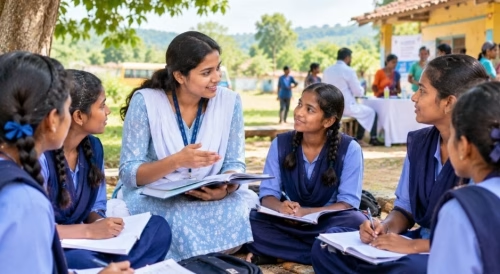
Rural colleges usually serve first-generation learners, students from economically weaker sections, and young women from conservative households who might not otherwise access higher education. This is not a limitation. Under Criterion 5 (Student Support and Progression) and Criterion 7 (Institutional Values and Best Practices), it is a genuine strength — if you document it properly.
Documenting What Already Exists
Most rural colleges already run scholarship support, remedial classes, vernacular-language mentoring, and hostel or transport arrangements for women students. The problem is rarely the absence of good work — it is the absence of records. Assign a nodal officer to log every scholarship disbursed, every remedial session held, and every mentoring interaction, with dates and headcounts.
Community and Extension Activities as Evidence
Village health camps, adult literacy drives, agricultural awareness programmes, and local school tutoring all map directly to Criterion 3 (Extension Activities) and Criterion 7 (Best Practices). Rural colleges are often embedded in their communities far more deeply than urban institutions. Capture this with photographs, attendance sheets, and a short annual extension report. For a deeper look at how these activities connect to your quality cell structure, see Role of IQAC in NAAC Accreditation on BhavyaGyan.
Localized Research: Your Untapped NAAC Advantage
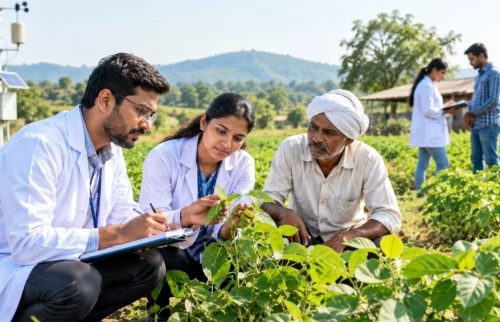
Rural and remote colleges sit close to agricultural land, local artisans, tribal communities, and unique regional ecosystems. This proximity is a research advantage most urban colleges simply do not have. Localized research — studies on regional crop patterns, indigenous knowledge systems, water conservation, rural entrepreneurship, or community health — carries genuine academic and social value, and it directly strengthens Criterion 3 (Research, Innovations and Extension).
The challenge for most rural HEIs is not a shortage of research ideas. It is a shortage of publishing infrastructure. Faculty often complete strong applied studies but have no reliable, affordable, peer-reviewed outlet to publish them in. This is where working with an established academic publisher matters. ManTech Publications, with over 12 years of experience and 90+ peer-reviewed, ISSN-registered, DOI-enabled journals across Engineering, Management, and Medical Sciences, gives rural faculty a credible, budget-friendly route to publish region-specific research. Our related guide, Cost-Effective Subscription Strategies for Tier-3 Institutes, outlines how smaller colleges can build a NAAC-credible research library without overspending.
📚 Explore Mantech’s Journal Subscription Services to give your faculty and students a legitimate, affordable outlet for regional research and reference material.
A 5-Step Strategic Planning Framework for Rural and Remote HEIs

Use this sequence to build a realistic, phased accreditation plan instead of a last-minute scramble.
- Run a location-specific gap analysis. Before opening the NAAC portal, map your real gaps against all ten key attributes, factoring in connectivity, faculty strength, and industry access. A generic gap analysis built for a city college will miss your actual risk areas.
- Build a hybrid documentation system. Keep both cloud storage and a local, offline-synced backup of every criterion folder, so slow connectivity never threatens a submission deadline.
- Formalize local partnerships. Convert informal community ties into signed MoUs with panchayats, local NGOs, primary health centres, and nearby industries. Signed documents carry far more DVV weight than verbal arrangements.
- Train faculty through virtual programmes. Where in-person FDPs are hard to arrange, use recorded and live virtual training for Outcome-Based Education (OBE) mapping and Student Satisfaction Survey (SSS) preparation.
- Plan peer team visit logistics months in advance. Identify accommodation, transport, and a clear campus walkthrough route that showcases your best practices first.
🎯 Get a criterion-by-criterion gap map built specifically for your location, faculty strength, and connectivity profile.
Common Mistakes Rural Colleges Make During NAAC Preparation
- Copying an urban college’s SSR structure instead of building one around actual regional strengths.
- Treating community outreach as informal goodwill rather than documented, criterion-mapped evidence.
- Assuming journal subscriptions are unaffordable and skipping Criterion 4 library upgrades, when affordable, NAAC-aligned journal options exist for Indian institutional budgets.
- Underestimating how much time DVV clarification queries need when internet access is inconsistent.
- Waiting until the peer team visit is confirmed before arranging local transport and accommodation.
Each of these mistakes is avoidable with early planning and the right consulting support.
How BGC Helps Rural and Remote Institutions Build Compliance Frameworks

Bhavya Gyan Consultants (BGC) works specifically with institutions that do not fit the standard urban accreditation mould. Their approach for rural and remote HEIs typically includes:
- A location-adjusted gap analysis that accounts for connectivity and faculty availability.
- Criterion-wise documentation support, including the NAAC Criterion 4 Documentation Checklist for infrastructure-constrained campuses.
- Mock peer team visits designed around your actual campus layout and travel logistics.
- IQAC formation and AQAR support for colleges building their quality cell from scratch.
Their guide on how to start NAAC preparation in a college is a useful starting point for institutions in the very early stages. And for prospective students comparing accredited colleges in their own region, platforms like BhavyaGyan increasingly influence admission decisions — making early accreditation planning a recruitment advantage as well as a compliance one.
📞 Contact us for customized compliance frameworks built for rural HEIs.
Conclusion
Rural and remote colleges do not need to imitate metro campuses to earn strong NAAC outcomes. They need a plan built around their real conditions: patchy connectivity, close community ties, and untapped research ground. Start with an honest gap analysis, document what your college already does well, and treat local research as an asset rather than an afterthought. With the right sequencing and the right support, a rural HEI can build a compliance framework that is just as strong as any urban institution’s — often stronger, because it is rooted in something real.
FAQs:
The same national process, adapted with planning for connectivity, faculty, and community-linked evidence gaps.
No. Criteria are identical; only the execution strategy and evidence types differ.
Keep offline backups and use a nearby town’s cyber café or CSC as fallback.
Yes. Extension and outreach work strengthens Criterion 3 and Criterion 7 scores.
Yes. Local, applied research on regional themes often ranks well in indexed journals.
Typically 12–18 months, given added logistics and connectivity challenges.
External Resources & References
These official, authoritative resources open in a new tab and support your institution’s planning:
- National Assessment and Accreditation Council: Official NAAC Portal
- University Grants Commission India: Official UGC Website
- All India Survey on Higher Education: Official AISHE Portal
- National Digital Library of India: Free Repository for Indian Educational Institutions
Leave a Reply