

Many colleges assume that having journal subscriptions is enough to satisfy NAAC. It is not. During Data Validation and Verification, peer teams ask a sharper question: can you show, day by day, that students and faculty actually use these resources? This is where library usage digital evidence becomes the deciding factor between a smooth DVV clarification and a repeated query.
Institutions often submit subscription invoices and login screenshots as proof. Reviewers reject these because they prove access, not usage. A subscription certificate shows the college paid for a resource. It does not show whether anyone opened it. NAAC’s evidence-heavy approach under the newer accreditation framework has made this gap painfully visible for hundreds of colleges every cycle.
This guide explains what genuine daily-use evidence looks like, how automated usage logs and e-journal analytics work together, and how any IQAC team — regardless of budget or technical skill — can build a defensible, date-stamped usage trail before the next SSR submission.
What Is Library Usage Digital Evidence?

Library usage digital evidence is any system-generated, timestamped record that shows real interaction with a library resource. This includes login counts, download logs, session duration, search history, and IP-based access records from a database or e-journal platform.
It is different from static proof like subscription invoices, MoUs, or a single screenshot taken once a year. Static proof shows that a resource exists. Digital evidence shows that people used it, when they used it, and how often. NAAC’s DVV process is built around this exact distinction, so institutions that mix the two categories usually receive a clarification query.
Why ‘Daily’ Matters More Than ‘Annual’
Peer teams increasingly ask for month-wise or day-wise usage patterns, not a single annual number. A report that says ‘500 downloads this year’ is far weaker than a report showing steady daily activity across all twelve months. Consistent daily patterns suggest genuine academic use. A sudden spike just before the SSR submission suggests the opposite, and reviewers are trained to notice it.
Why NAAC Peer Teams Question Journal Usage Data

Peer teams are not being difficult when they ask for deeper proof. Two facts drive their caution. First, some colleges have submitted screenshots or reports that were clearly generated in bulk just before the visit. Second, Criterion I and Criterion III both depend heavily on library and journal engagement, so weak documentation directly affects the final score.
Common DVV Clarification Triggers
- Usage numbers that do not match the number of enrolled students or research scholars
- No IP-range or campus-network verification for remote-access claims
- Missing correlation between journal subscriptions and faculty publication output
- Usage reports built in an identical format every year, suggesting manual editing
- No distinction between walk-in library visits and digital resource access
Any single one of these can trigger a formal clarification request, adding weeks to the accreditation timeline.
The Core Building Blocks of a Defensible Usage Trail

A strong usage trail rests on three pillars: automated logs, platform-level analytics, and proof that the resource was actually reachable when claimed.
Automated Usage Logs
Automated usage logs are records generated automatically by your library management system, OPAC, or e-journal gateway — never typed manually into a spreadsheet. They capture login timestamps, user ID or department, resource accessed, and session duration. Because they are machine-generated, they carry far more credibility with peer teams than manually compiled logs.
Most modern library software and journal platforms can export these logs monthly. The key is exporting and archiving them on a routine, not compiling them once a year right before the SSR is due.
E-Journal Analytics
E-journal analytics go one level deeper than raw logs. They reveal patterns: which departments use which journals most, peak usage hours, article-level download counts, and comparisons across semesters. When a college can pair a graph of monthly usage with a spike during exam or research-submission periods, it tells a believable academic story instead of a random number.
Colleges that subscribe through Mantech Publications’ journal subscription plans gain access to usage dashboards that already separate data by department and month, which saves the IQAC team weeks of manual compilation.
Resource Accessibility Proof
The final pillar is proof that the resource was actually reachable — no broken links, no expired IP authentication, no lapsed subscription window. NAAC checks accessibility because a subscribed-but-unreachable resource cannot generate genuine usage. Screenshot the access portal periodically, keep IP-whitelisting records from your network team, and retain renewal certificates alongside usage exports.
Step-by-Step Framework to Track Daily Journal Usage
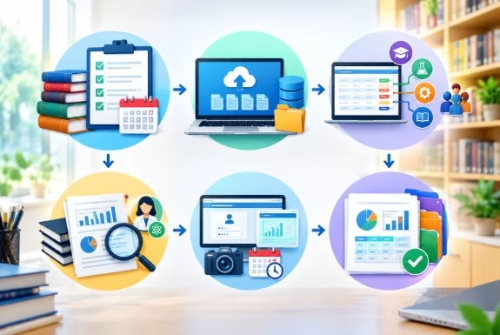
Building this evidence trail does not require expensive software. It requires consistency.
Step 1 — Centralise Every Subscription in One Register
List every journal, database, and e-resource with subscription start and end dates. This becomes the backbone against which all usage data is checked.
Step 2 — Enable Automatic Log Export
Configure your library system to export usage logs monthly, in the same format every time. Store them in a shared IQAC drive, not on individual staff laptops.
Step 3 — Map Usage to Departments and Courses
Tag each log entry with the department or course it supports. This lets you answer the peer team’s question, ‘How does this journal support your curriculum?’ with data instead of guesswork.
Step 4 — Cross-Check With Faculty Research Output
Match high-usage journals against faculty publications and citations from the same period. This single step answers most Criterion III clarification queries before they are even raised.
Step 5 — Archive Screenshots and Access Proof Quarterly
Take dated screenshots of the login portal and usage dashboard every quarter, not once a year. Quarterly evidence is far more convincing than a single annual capture.
Step 6 — Prepare a One-Page Usage Summary Per Criterion
Convert raw logs into a simple one-page summary chart for each relevant NAAC criterion. Reviewers spend limited time per document, so clarity matters as much as accuracy.
Common Mistakes Colleges Make During DVV Checks

- Treating subscription invoices as proof of usage
- Compiling usage reports only in the final month before submission
- Using inconsistent report formats year over year
- Ignoring department-wise or course-wise usage mapping
- Failing to retain IP-authentication or remote-access records
- Storing evidence on personal devices instead of a shared institutional repository
Each of these mistakes is fixable with a documented monthly routine rather than a last-minute scramble.
How the Right Subscription Partner Makes Evidence Easier
A journal subscription provider that offers built-in analytics saves the library team significant manual work. Look for dashboards that break usage down by department, provide monthly and annual comparisons, and export data in NAAC-friendly formats.
Mantech Publications’ subscription plans include usage-tracking support so colleges do not have to build reporting systems from scratch, and our journal catalogue across engineering, management, pharmacy and nursing disciplines matches most institutional needs in one place. Institutions that also publish faculty research through our paper publication services often find it easier to demonstrate the link between journal access and research output, since both records sit under one accreditation trail.
Turning Library Records Into Accreditation-Ready Documentation
Collecting logs is only half the work. NAAC’s DVV team expects the evidence to be organised criterion-wise, cross-referenced, and ready to defend during a peer team query — and this is exactly where most IQAC teams get stuck, because library staff understand usage data but not accreditation formatting.
This is the point where dedicated accreditation consultants add real value. Bhavya Gyan Consultants (BGC) works with colleges specifically on DVV clarification support, helping institutions convert raw library and journal logs into criterion-wise evidence that survives peer team scrutiny. Their digital evidence repository framework also gives colleges one organised place to store logs, screenshots, and usage summaries instead of scattering them across departments.
If your library team already has usage data but is unsure how to present it, BGC’s SSR preparation services can help align it with the rest of your self-study report before submission. You can also check their DVV readiness checklist for a quick self-audit.
Institutions that keep their digital records organised also build more trust with prospective students. Learners researching colleges on platforms such as BhavyaGyan’s student guidance portal increasingly judge institutions by how transparent and well-documented their public information is, so the same discipline that helps with DVV checks also helps with admissions.
Conclusion
Daily journal usage does not have to be a source of anxiety during NAAC visits. When a college builds simple habits — monthly automated exports, department-wise mapping, quarterly screenshots, and criterion-wise summaries — library usage digital evidence becomes one of the strongest parts of the SSR rather than the weakest. Start small: pick one journal, export one month of logs, and map it to one department. Repeat this every month, and by the next accreditation cycle your library will have twelve clean, consistent data points instead of one rushed report.
FAQs:
System-generated logs like logins, downloads, and session data — not invoices or screenshots alone.
Daily patterns show genuine, ongoing use rather than activity created just before submission.
No. Invoices prove payment only, not that anyone accessed or used the resource.
Every month, in a consistent format, stored in a shared institutional repository.
Mismatched numbers, missing IP records, or usage reports that look manually edited.
Accreditation consultants like BGC can structure logs into criterion-wise, defensible documentation.
Yes. Criterion III checks whether journal access supports actual faculty research output.
Start exporting one journal’s monthly usage log and mapping it to a department.
Leave a Reply