

NAAC’s new framework has changed what Governance and Administration NAAC assessment actually looks for. Under the old system, colleges could lean on a strong self-study report and a persuasive peer team visit. That approach no longer works.
Institutions aiming for MBGL Level 4 face something tougher: a physical peer visit, AI-verified data, and governance systems that must hold up under scrutiny, not just look good on paper. For a full walk through of how Binary Accreditation and the five MBGL levels work, Mantech Publications’ complete guide to NAAC’s new Binary Accreditation and MBGL framework is a useful starting reference before you dive into this governance-specific breakdown.
This article focuses on one piece of that puzzle: governance and administration. We will look at what MBGL Level 4 expects from institutional leadership, how transparency logs and policy automation reduce risk, and what a practical roadmap looks like for colleges preparing to move up the maturity ladder.
What MBGL Level 4 Demands From Institutional Governance

MBGL Level 4, called the Advanced stage, is not a digital-only review. It requires a physical peer team visit and evaluates advanced institutional practices, research output, and governance maturity together. Assessors are not just checking whether policies exist. They are checking whether those policies are actually followed, dated, minuted, and traceable across years.
Two structural pieces sit behind this evaluation. The seven criteria — including Criterion 6, Governance, Leadership and Management — remain the broad framework. Alongside them, the ten new attributes introduced under the revised system include Attribute 3: Governance, Leadership and Institutional Management, which now functions as a specific, scored evaluation unit rather than a background factor.
For an institution targeting Level 4, this means governance can no longer sit quietly behind academics and infrastructure. It becomes one of the metrics that decides whether the institution clears the bar.
Why Governance and Administration Decide the MBGL Outcome
From Documentation Volume to Verified Systems
Under the earlier grading system, a thick file of policies often satisfied the peer team. Under the revised framework, data is cross-checked against national databases, and every governance claim needs a verifiable trail behind it. A policy that exists only as a PDF, with no minutes, no revision history, and no evidence of implementation, is now a liability rather than an asset.
The Role of Institutional Leadership Strategy
A sound institutional leadership strategy gives every governance claim a chain of custody: who approved a policy, when it was reviewed, and how departments implemented it. Institutions that treat leadership strategy as a standing system — not a one-time SSR exercise — tend to move through governance-related metrics with far fewer flags.
Building a Transparency Log System Institutions Can Trust

A transparency log is a dated, chronological record of governance activity: committee meetings, policy approvals, grievance resolutions, budget decisions, and leadership actions. It is the difference between saying a process happens and proving it happens on schedule.
What a Transparency Log Should Track
- Dates and attendance for every statutory and academic committee meeting
- Action Taken Reports linked back to each decision
- Policy version history, including who approved each revision and when
- Grievance redressal timelines from complaint to closure
- Public disclosure updates on the institutional website
Common Transparency Gaps at Level 4 Review
Most institutions do not fail governance review because processes are absent. They fail because the paper trail is incomplete, inconsistent in format, or scattered across departments. A single institution-wide log, maintained centrally, closes this gap and gives IQAC one place to pull evidence from during a peer visit.
BGC’s Institutional Transparency Pages service and our Digital Evidence Repository work together to structure this kind of log so it survives both a digital audit and a physical peer team visit.
Not sure where your transparency and governance systems currently stand?
Policy Automation: Reducing Manual Error in a Digital-First Framework
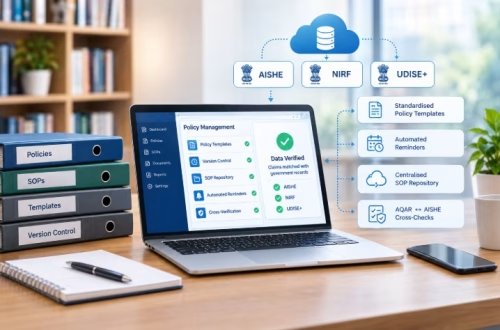
NAAC’s new assessment model runs on a One Nation One Data Platform that automatically checks institutional claims against AISHE, NIRF, and UDISE+ records. Manual, spreadsheet-based policy tracking cannot keep pace with this. Policy automation — using structured templates, version control, and centralised SOP repositories — reduces the chance that a governance claim on your NAAC submission contradicts a government database.
Where Automation Fits Into Governance
- Standardised policy templates so every department documents decisions the same way
- Automated reminders for policy review cycles, so nothing lapses silently
- Centralised SOP repositories that replace scattered department-level files
- Cross-checks between AQAR data and AISHE submissions before they go public
This is exactly the gap our Policy & SOP Development team closes — building policy and SOP systems that are structured once and maintained consistently, instead of rebuilt from scratch before every accreditation cycle. Institutions can also use our ERP & Documentation Systems services to move this tracking off spreadsheets entirely.
Institutional Leadership Strategy for MBGL Level 4
Building Leadership Accountability
Governance maturity is ultimately a leadership question. Assessors at Level 4 are looking for evidence that decisions travel predictably from leadership to department to classroom, and that there is a named person accountable at each stage. A governance chart with no accountability trail behind it does not hold up during a physical visit.
Aligning IQAC With Institutional Leadership
IQAC cannot function as a documentation cell that operates separately from leadership. For Level 4 readiness, IQAC needs a direct reporting line to the top of the institution, with quarterly reviews that leadership actually attends and signs off on. Our IQAC Establishment and Management services are built around this alignment, so quality assurance and institutional leadership move in step rather than in parallel.
Institutions that also list their programmes on student-facing platforms should keep in mind that accreditation status increasingly shapes discoverability. BhavyaGyan’s college and course directory is one example of a platform where students actively filter institutions by accreditation status, so governance credibility has a direct, visible payoff beyond the NAAC portal itself.
A Practical Governance Roadmap to MBGL Level 4

Institutions that are already Binary Accredited and preparing to climb toward Level 4 should treat governance as a sequential build, not a last-minute exercise.
Step 1: Audit Current Governance Documentation
Start with a full Academic & Administrative Audit to see exactly where policy, SOP, and minutes documentation stands today, department by department.
Step 2: Centralise the Transparency Log
Move every committee minute, policy approval, and grievance record into one dated, searchable system rather than scattered department folders.
Step 3: Automate Policy Review Cycles
Set recurring review dates for every policy so nothing lapses unnoticed, and assign a named owner to each document.
Step 4: Rehearse the Physical Visit
Since Level 3 and above require a peer team on campus, run a mock Peer Team Visit Preparation session so leadership and department heads can speak to governance evidence confidently, not just present it.
Step 5: Cross-Verify Against Government Data
Reconcile every governance and administrative claim against AISHE and NIRF submissions before applying, since mismatches are now flagged automatically.
Common Governance Mistakes That Delay MBGL Progress
- Treating IQAC as a paperwork unit rather than a leadership-linked quality function
- Storing policies as static files with no version history or review dates
- Letting committee minutes lag weeks behind actual meetings
- Preparing governance evidence only in the months before an SSR is due
- Leaving grievance redressal timelines undocumented until a complaint escalates
Want a clear picture of your institution’s current governance maturity before you apply?
Conclusion
Governance and administration are no longer a background chapter in your NAAC file — they are a scored, verified attribute that can decide whether your institution reaches MBGL Level 4. Transparency logs turn governance claims into evidence. Policy automation keeps that evidence consistent and current. And a clear institutional leadership strategy ties both together so the whole system holds up under a physical peer visit, not just a digital review.
Institutions that begin this work early, rather than waiting for the portal to force their hand, are the ones most likely to move smoothly through Level 4 and beyond. For continued research and updates on how the framework is evolving, Mantech Publications’ NAAC education series is worth bookmarking alongside this guide.
Want the complete Binary Accreditation and MBGL framework explained end to end?
FAQs:
MBGL Level 4 is the “Advanced” maturity stage, requiring a physical peer visit and strong governance evidence.
Governance is now a scored attribute, verified against records, not just a documentation checklist.
A dated record of meetings, approvals, and decisions that proves governance processes actually happened.
Yes. Even a shared template and review calendar counts as basic policy automation.
Yes, physical peer team visits apply from MBGL Level 3 onward, including Level 4.
Ideally 12–18 months before applying, since evidence needs a real history, not a fresh file.
No. IQAC coordinates it, but leadership accountability must be visible throughout.
Leave a Reply