
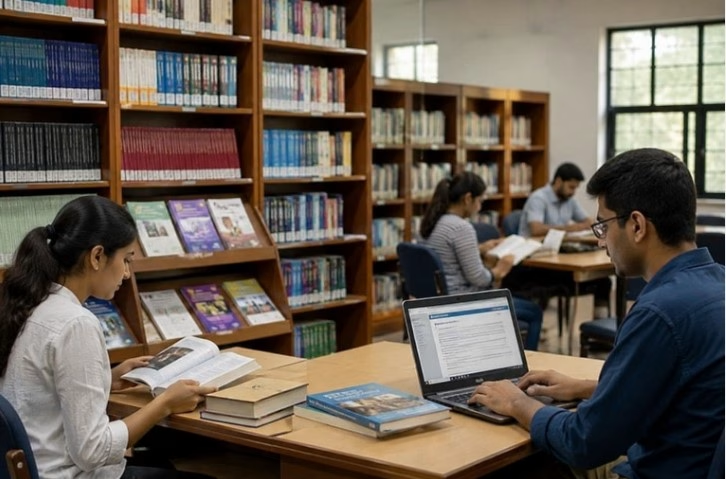
Walk into any college library today and you will notice a quiet shift. Journal racks are shrinking. Login credentials for digital databases are piling up in the librarian’s inbox instead. E-journals promised faster access, lower storage costs, and one search box for everything. On many counts, they delivered. But colleges working through NAAC accreditation, AICTE compliance, or simply a stronger research culture are learning that going fully digital is not a free upgrade. It is a trade-off, and nobody explained the fine print.
This is the case for keeping peer-reviewed print journals in the mix, alongside digital, not instead of it. If your institution is comparing print journal subscriptions college librarians can actually defend during an audit, this guide walks through exactly where print still pulls its weight.
The Digital-Only Assumption in College Libraries
Many purchase committees now treat e-journals as the obvious upgrade over print. The logic seems sound: digital access works for many users at once, needs no shelf space, and lets students search across thousands of pages in seconds. But that logic only holds if every other condition stays perfect: stable internet, uninterrupted subscriptions, and publishers who never change their platforms. In Indian higher education, those conditions rarely hold for long.
The shift toward digital-only libraries has often happened by default rather than by decision. A renewal cycle comes up, a digital bundle looks cheaper on paper, and print titles get quietly dropped without anyone weighing what the institution actually loses. Few library committees sit down and ask what a fully digital collection cannot do. That gap in planning is exactly where problems show up later, usually during an accreditation visit or a dissertation dispute over a citation.
What E-Journals Do Well
- Instant access for multiple students and faculty at the same time
- No physical storage, binding, or shelf maintenance cost
- Fast keyword search across large volumes of text
- Easy circulation across departments and campuses
What Gets Left Out When Print Disappears Completely
- Access can vanish overnight if a subscription lapses or a publisher changes its licensing terms
- Screenshots and PDFs are easy to alter, making citation checks harder to trust
- Every reading session depends on working internet and a working device
- Students lose the habit of browsing physical shelves, which often leads to unplanned but useful discoveries
- Auditors reviewing physical infrastructure find little tangible evidence to point to
Why Print Still Counts for Learning Resource Metrics
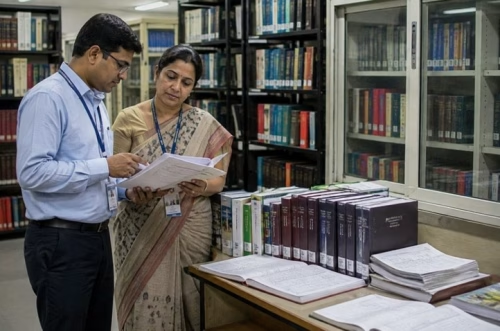
Accreditation frameworks in India were not built with a digital-only library in mind. Most still separate physical holdings from e-resource subscriptions when scoring learning resource metrics, which means a library that has gone fully digital may be under-reporting its actual strength on paper.
NAAC, AICTE and the Weight of Physical Library Resources
NAAC’s Criterion 4 evaluates infrastructure and learning resources, and physical library resources are assessed as a distinct component from e-resources. Peer Teams still walk through the library during institutional visits, and DVV clarification queries often ask for physical proof: subscription receipts, accession registers, and shelf photographs that an online-only subscription simply cannot produce. AICTE’s library standards for approved technical institutions also expect a baseline of print holdings alongside digital access, not one in place of the other.
Countable, Verifiable Holdings
An ISSN sticker, an accession number, and a fixed shelf location create a paper trail that a DVV reviewer or an internal auditor can check against institutional records within minutes. This kind of verifiable evidence is difficult to replicate with a login-based digital subscription, where access can only be confirmed through a publisher’s certificate rather than something physically present on campus.
See the full range before you decide:
Text Verification: The Quiet Advantage of Print Journals
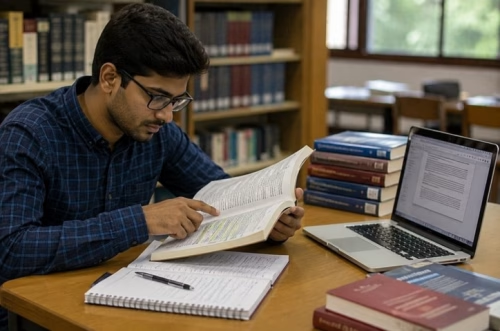
Beyond accreditation paperwork, print journals solve a research problem that rarely gets discussed: verifying that a cited text has not changed since it was published.
Why Text Verification Matters for Research Quality
A printed journal is fixed the moment it is bound and shelved. It cannot be silently edited, re-paginated, or quietly corrected without a visible erratum notice. For dissertation committees, plagiarism checks, and peer review, this fixed, dated text is far easier to verify against a citation than a PDF that may render differently depending on the device, browser, or software version used to open it. Text verification against a physical, unchangeable copy remains one of the simplest ways to confirm that a quoted passage says exactly what a paper claims it says.
Permanence Versus Platform Dependency
Digital-only access carries a quiet risk: link rot, broken DOIs, discontinued publisher platforms, and paywalls that reappear the moment a subscription ends. A research paper cited from a webpage two years ago may point to a page that no longer exists. A bound print volume on a library shelf does not disappear when a vendor contract lapses or a platform gets redesigned. For long-term institutional memory and future citation checks, that permanence has real value.
This matters most for faculty building a research career over many years. A professor citing their own earlier published work needs that original text to remain retrievable in exactly the form it was published, ten or fifteen years later. Publishers do occasionally shut down platforms, get acquired, or migrate archives in ways that break old links. A library that kept the bound print volume never loses that history, regardless of what happens to any single publisher’s website.
The Ground Reality: Connectivity Gaps in Indian Colleges
For colleges outside major metros, digital-only access assumes a level of connectivity that does not always exist. Campus wifi may be limited to certain hours, internet speed may drop during exam season when everyone is online at once, and rural campuses may face outages that last for days. Every one of these situations locks students and faculty out of digital-only resources at exactly the moment they need them most. Print journals sitting on a shelf are immune to all of it.
There is also a quieter, human factor at play. Not every student is equally comfortable reading long, technical articles on a screen. Final-year students preparing dissertations, and faculty writing late into the evening, often prefer a printed copy they can annotate, flip through, and compare page by page. Removing that option entirely does not just create a technical gap, it removes a genuine study preference that many researchers still rely on.
Building a Balanced Library: Print Plus Digital
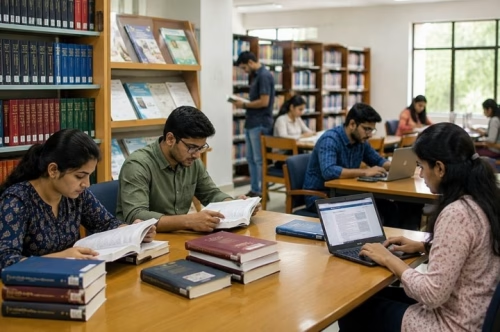
None of this is an argument against digital access. It is an argument against treating print and digital as competitors rather than partners. A well-planned library uses each format for what it does best.
A Practical 5-Step Framework
- Identify programme-critical titles across your Science & Technology, Management, or Medical Science streams: the 3 to 5 journals every core department genuinely uses, and subscribe to those in print
- Layer digital subscriptions on top for breadth, giving students access to more titles than the print budget alone could cover
- Reserve print for reference and long-shelf-life titles that faculty and researchers will still cite five years from now
- Use digital for fast-turnover, current-awareness titles where speed matters more than permanence
- Document both formats separately in your accreditation records, since physical and e-resources are usually scored as distinct metrics
Ready to build a print-and-digital plan that fits your budget?
How Print Journal Subscriptions Strengthen Accreditation Documentation
For IQAC Coordinators, the accreditation case for print is often stronger than the research case. Physical library resources feed directly into Criterion 4 evidence, and colleges that can show a genuine, growing print collection alongside digital access tend to face fewer DVV clarification queries on library metrics.
Turning a mixed print-and-digital collection into a clean, criteria-wise evidence file is its own specialised task, and one that many IQAC teams underestimate until the SSR deadline is close.
If your institution needs help structuring this evidence correctly, BGC’s Criteria-wise Documentation Support specialises in exactly this kind of gap analysis, covering every NAAC criterion, not just the library section.
Need your library evidence audit-ready before the next SSR cycle?
What Students Gain When Print Journals Stay on the Shelf
Students preparing for competitive exams, dissertations, or clinical postings in nursing, pharmacy, and allied health programmes benefit from having a dependable, always-on print collection to fall back on, especially during internet outages or exam-season server strain on digital portals. A library that visibly maintains both formats also signals something to prospective students: that the institution invests in real research infrastructure, not just a login page.
Students comparing colleges before applying can check this kind of infrastructure detail directly. Platforms like BhavyaGyan’s verified college and course listings help students look beyond brochures, while its guide to NAAC accreditation explains why accredited institutions with strong library metrics are usually a safer long-term choice.
Guiding students or parents through college shortlisting?
Conclusion
E-journals are not the problem. Treating them as a complete replacement for print is. The strongest college libraries in India are not choosing one format over the other. They are pairing a focused, well-chosen print collection with broad digital access, and documenting both clearly for research, for students, and for accreditation. If your library is due for a subscription review, that review is the right moment to ask not “print or digital,” but “how much of each, and for which titles.”
FAQs:
Yes. NAAC and AICTE assess physical library resources separately from e-resources, so print still matters.
Yes, Peer Teams often review physical holdings, accession registers, and shelf displays during campus visits.
It means confirming a citation matches the original, unedited text. Print offers a fixed, dated reference.
Not fully. Connectivity gaps, platform changes, and accreditation evidence needs still favour keeping some print.
Focus on 3 to 5 core, programme-relevant titles per department rather than spreading budget too thin.
Yes. Mantech offers ISSN-registered, peer-reviewed journals in print, digital, and combined formats.
Physical resources are scored as a distinct learning resource metric, separate from e-resource subscriptions.
BGC Global offers criteria-wise documentation support covering library and all other NAAC criteria.
External Resources & References
AICTE Library Standards for approved technical institutions: aicte-india.org
UGC-CARE List — approved journals for academic recognition: ugccare.unipune.ac.in
Leave a Reply