
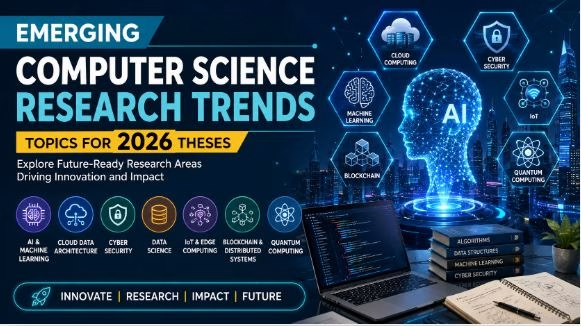
Computer science research trends are evolving faster than ever as artificial intelligence, cloud computing, cyber security, blockchain, quantum computing, and intelligent automation reshape industries worldwide. For engineering colleges and universities, selecting relevant research topics has become essential for improving research quality, attracting funding, publishing in reputed journals, and enhancing institutional rankings.
Academic leaders, including principals, directors, department heads, faculty members, and IQAC coordinators, must ensure that research projects align with industry requirements, national education priorities, and accreditation expectations. Modern thesis topics should not only demonstrate technical innovation but also address real-world challenges that industries and society face today.
This guide explores the most promising Computer science research trends for 2026, explains why they matter for higher education institutions, and provides a structured roadmap for helping students and researchers select impactful thesis topics.
Strengthen institutional research excellence with expert BGC consultation today.
1. Understanding Computer Science Research Trends
Computer science is one of the fastest-changing academic disciplines. Every year, new technologies emerge, creating fresh opportunities for research and innovation. Universities that continuously update their research priorities are better positioned to produce high-quality publications, industry collaborations, patents, and successful student projects.
Research trends are influenced by several factors, including technological advancements, government initiatives, industry demand, and global challenges. Institutions that encourage students to work on contemporary topics are more likely to improve research visibility and contribute meaningfully to the broader academic community.
Some of the key areas currently driving computer science research include:
- Artificial Intelligence
- Machine Learning
- Cyber Security
- Cloud Computing
- Data Science
- Blockchain
- Internet of Things (IoT)
- Edge Computing
- Quantum Computing
- Robotics
- Human-Computer Interaction
- Sustainable Computing
These domains offer opportunities for interdisciplinary research and practical applications across sectors such as healthcare, education, finance, manufacturing, agriculture, and public administration.
How Research Trends Influence Institutional Growth
Keeping pace with current research trends can help institutions:
- Improve publication quality.
- Increase funded research projects.
- Strengthen industry collaborations.
- Support innovation and entrepreneurship.
- Enhance institutional reputation.
- Contribute to accreditation and ranking performance.
For students, selecting an emerging research topic improves employability, technical expertise, and opportunities for higher studies.
2. Why Computer Science Research Trends Matter for Colleges and Universities
The quality of research produced by an institution is a key indicator of academic excellence. Aligning thesis topics with emerging technologies helps colleges remain competitive in both academic and industry landscapes.
Enhancing Research Output
Research aligned with current technological developments is more likely to lead to quality publications, conference presentations, patents, and collaborative projects.
Topics such as AI and machine learning papers, cloud data architecture, and cyber security continue to attract significant academic and industrial interest.
Supporting Accreditation and Rankings
Research performance plays an important role in institutional assessments. Strong research output contributes to:
- Higher publication counts.
- Increased citation impact.
- Better innovation metrics.
- Enhanced faculty profiles.
- Improved research ecosystem.
These outcomes support institutional quality initiatives and strengthen accreditation readiness.
Bridging Academia and Industry
Modern organizations seek graduates who have worked on practical, future-ready technologies. Institutions that encourage industry-relevant research improve placement opportunities and build stronger partnerships with technology companies.
Encouraging Interdisciplinary Innovation
Computer science increasingly overlaps with fields such as:
- Biotechnology
- Healthcare
- Agriculture
- Environmental Science
- Finance
- Education
- Smart Cities
Interdisciplinary projects often address complex societal challenges and create opportunities for collaborative research.
Strengthening Institutional Research Culture
A research-driven culture encourages continuous learning, innovation, and collaboration among students and faculty. It also helps institutions build sustainable research ecosystems that support long-term academic growth.
3. Top Emerging Computer Science Research Trends for 2026
Selecting a thesis topic should be based on three important factors:
- Current industry demand
- Research novelty
- Availability of datasets, tools, and faculty expertise
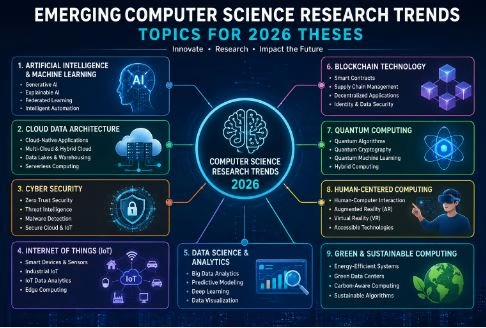
Below are some of the most promising Computer science research trends expected to dominate research in 2026.
3.1 Artificial Intelligence and Machine Learning
Artificial Intelligence continues to transform almost every industry. Research is rapidly moving beyond prediction models toward explainable, trustworthy, and responsible AI systems.
Popular thesis areas include:
- Explainable AI (XAI)
- Generative AI applications
- Federated Learning
- AI Ethics
- Autonomous Decision Systems
- Healthcare AI
- AI-powered Education Systems
- AI for Smart Cities
Students working on AI and machine learning papers should focus on solving real-world problems instead of merely implementing existing algorithms.
Book your institutional research quality assessment with BGC experts.
3.2 Cloud Data Architecture
Modern organizations process enormous amounts of structured and unstructured data every day.
As cloud adoption increases, research opportunities continue expanding in:
- Distributed databases
- Hybrid cloud infrastructure
- Multi-cloud architecture
- Cloud security
- Container orchestration
- Kubernetes optimization
- Serverless computing
- Cloud-native application design
Research on cloud data architecture is especially valuable for institutions collaborating with software industries.
3.3 Cyber Security
Cyber threats continue evolving rapidly, creating demand for innovative security solutions.
Potential research areas include:
- Zero Trust Architecture
- Digital Identity Management
- Threat Intelligence
- Malware Detection
- Secure Cloud Computing
- Blockchain Security
- IoT Security
- Ransomware Prevention
Since cyber security affects every digital sector, institutions should encourage interdisciplinary collaboration with networking and information technology departments.
3.4 Data Science and Predictive Analytics
Data-driven decision-making remains a priority across industries.
Emerging topics include:
- Big Data Analytics
- Deep Learning
- Time Series Forecasting
- Medical Data Analytics
- Financial Risk Prediction
- Educational Analytics
- Business Intelligence
- Smart Manufacturing
These research areas combine statistics, programming, machine learning, and visualization techniques.
3.5 Internet of Things (IoT)
Connected devices continue transforming healthcare, transportation, agriculture, and smart cities.
Research opportunities include:
- Smart Agriculture
- Industrial IoT
- Healthcare Monitoring
- Smart Homes
- Smart Transportation
- Sensor Networks
- IoT Data Analytics
- Edge Computing
3.6 Quantum Computing
Although still emerging, quantum computing is becoming increasingly important in academic research.
Possible topics include:
- Quantum Algorithms
- Quantum Cryptography
- Quantum Machine Learning
- Quantum Error Correction
- Hybrid Classical-Quantum Computing
3.7 Blockchain Beyond Cryptocurrency
Blockchain research has expanded well beyond digital currencies.
Popular applications include:
- Academic Credential Verification
- Supply Chain Management
- Healthcare Records
- Voting Systems
- Digital Identity
- Land Records
- Smart Contracts
3.8 Human-Centered Computing
Future software systems must become more intuitive and accessible.
Research themes include:
- Human-Computer Interaction
- User Experience Design
- Accessibility Technologies
- Virtual Reality
- Augmented Reality
- Mixed Reality
- Digital Learning Systems
3.9 Green Computing
Environmental sustainability is becoming an important research objective.
Potential research includes:
- Energy-Efficient Algorithms
- Sustainable Data Centers
- Carbon-Aware Computing
- Green Cloud Computing
- Renewable Energy Integration
3.10 Robotics and Intelligent Automation
Automation continues expanding across manufacturing, healthcare, logistics, and agriculture.
Research opportunities include:
- Autonomous Robots
- Collaborative Robots
- Medical Robotics
- Agricultural Robotics
- AI Robotics
- Industrial Automation
4. Step-by-Step Framework for Selecting High-Impact Thesis Topics
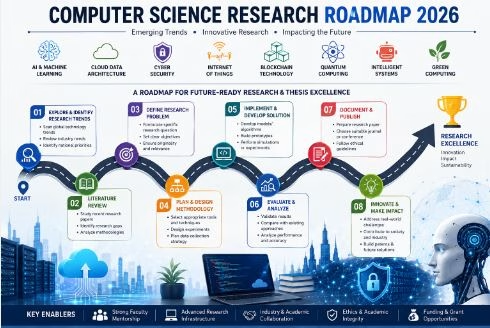
Choosing a research topic should be a systematic process rather than selecting a trending keyword. Institutions can adopt the following framework to guide students and research scholars.
Step 1: Identify National and Global Technology Priorities
Review technology reports, government initiatives, and industry developments to understand areas with growing research demand.
Examples include:
- Artificial Intelligence
- Digital India initiatives
- Smart Manufacturing
- Industry 5.0
- Sustainable Computing
- Cyber Security
Step 2: Review Recent Research Publications
Encourage students to analyze recent papers from:
- IEEE
- ACM Digital Library
- Springer
- Elsevier
- Scopus-indexed journals
This helps identify research gaps and emerging opportunities.
Step 3: Match Faculty Expertise
A strong thesis requires effective mentorship.
Institutions should align projects with faculty specialization while encouraging interdisciplinary collaboration where appropriate.
Step 4: Define a Practical Research Problem
Instead of selecting broad topics like “Artificial Intelligence,” define specific research questions.
Example:
❌ Artificial Intelligence
✔ AI-Based Early Disease Prediction Using Explainable Machine Learning Models
Download the research readiness checklist for future-focused computer science programs.
Step 5: Evaluate Resource Availability
Before approving a topic, verify access to:
- Software tools
- Datasets
- Hardware
- Cloud platforms
- Laboratory facilities
- Research funding
Step 6: Assess Innovation Potential
Good research should contribute something new by:
- Improving existing methods
- Developing novel algorithms
- Addressing practical challenges
- Combining multiple technologies
- Solving local or industry-specific problems
Step 7: Plan for Publication
Institutions should encourage students to design research with publication potential.
A publishable thesis typically includes:
- Clear objectives
- Comprehensive literature review
- Robust methodology
- Experimental validation
- Practical significance
Computer Science Thesis Readiness Checklist
| Checklist Item | Status |
|---|---|
| Industry-relevant topic selected | ✔ |
| Literature review completed | ✔ |
| Research gap identified | ✔ |
| Objectives clearly defined | ✔ |
| Dataset available | ✔ |
| Required software identified | ✔ |
| Ethical considerations reviewed | ✔ |
| Faculty supervisor assigned | ✔ |
| Publication opportunities explored | ✔ |
| Timeline prepared | ✔ |
5. Common Mistakes Institutions Should Avoid When Selecting Research Topics
Even institutions with strong academic programs sometimes struggle to produce impactful research because thesis topics are selected without a long-term strategy. Avoiding these common mistakes can significantly improve research quality and publication outcomes.
Choosing Generic Research Topics
Many students select broad topics such as Artificial Intelligence or Cloud Computing without identifying a specific research problem. A successful thesis should focus on solving a defined challenge rather than providing a general overview of a technology.
Ignoring Industry Requirements
Research disconnected from industry applications often has limited practical value. Institutions should encourage projects that address real-world challenges faced by businesses, healthcare, education, manufacturing, agriculture, or government organizations.
Weak Literature Review
A limited review of recent publications can result in duplicated research or missed opportunities for innovation. Students should study recent papers from reputed journals and conferences before finalizing a topic.
For guidance on preparing quality manuscripts, readers can explore Mantech Publications’ article on Research Paper Writing:
Poor Dataset Planning
Many projects fail because researchers finalize the topic before confirming whether relevant datasets are available.
Before beginning implementation, verify access to:
- Public datasets
- Institutional data (with permissions)
- Simulation tools
- Cloud resources
- Laboratory infrastructure
Ignoring Ethical Considerations
Projects involving human participants, healthcare information, financial records, or educational data require ethical approval and secure data handling practices.
Lack of Publication Planning
Research should be designed with publication in mind from the beginning rather than after project completion.
Institutions should encourage students to:
- Document experiments carefully.
- Maintain reproducible results.
- Use proper citations.
- Follow plagiarism guidelines.
- Select appropriate journals.
6. Best Practices for Building a Future-Ready Computer Science Research Ecosystem
Institutions aiming to stay aligned with Computer science research trends should move beyond isolated student projects and create a sustainable research ecosystem.
Develop Annual Research Roadmaps
Departments should review emerging technologies each academic year and identify priority research domains based on:
- National initiatives
- Industry demand
- Faculty expertise
- Funding opportunities
- Student interests
Build future-ready research ecosystems with expert academic quality support.
Promote Interdisciplinary Collaboration
Many high-impact innovations emerge at the intersection of multiple disciplines.
Examples include:
- AI in Healthcare
- Smart Agriculture
- FinTech
- Educational Technology
- Bioinformatics
- Sustainable Computing
Strengthen Industry Partnerships
Collaborating with industry enables institutions to:
- Access real-world datasets
- Identify practical research problems
- Offer internships
- Improve placement opportunities
- Support technology transfer
Invest in Modern Research Infrastructure
Future-focused research requires access to:
- High-performance computing
- Cloud platforms
- AI development environments
- Cybersecurity laboratories
- IoT testing environments
- Robotics equipment
Build Faculty Research Capacity
Faculty development programs should include training on:
- Research methodology
- AI tools for research
- Academic writing
- Patent filing
- Research ethics
- Grant proposal writing
7. How BGC Can Support Research-Oriented Institutions
Developing a high-quality research culture requires structured planning, documentation, academic mentoring, and continuous quality improvement. BGC works with higher education institutions to strengthen systems that support research excellence alongside accreditation readiness.
Our services include:
- NAAC Accreditation Consultancy
- NBA & OBE Implementation Support
- IQAC Strengthening
- Academic and Administrative Audit
- Documentation Support
- NIRF Ranking Readiness
- Website Structuring for Accreditation
- Institutional Quality Improvement Planning
These services help colleges align academic processes, research initiatives, and quality assurance practices with institutional objectives.
Improve research quality through professional institutional consulting services today.
Official External Links
Use only official references where relevant:
Conclusion
The future of higher education research depends on identifying meaningful and innovative Computer science research trends that address both academic challenges and real-world problems. Areas such as AI and machine learning papers, cloud data architecture, and cyber security will continue to shape research agendas in 2026 and beyond.
For colleges and universities, encouraging research aligned with emerging technologies is more than an academic exercise—it strengthens publication quality, enhances faculty expertise, supports accreditation goals, and prepares students for evolving industry demands. By adopting structured research planning, promoting interdisciplinary collaboration, and investing in modern research infrastructure, institutions can build a sustainable ecosystem that benefits students, faculty, and society alike.
FAQs:
Key research areas include Artificial Intelligence, Machine Learning, Cyber Security, Cloud Computing, Blockchain, Quantum Computing, Internet of Things, Green Computing, Robotics, and Data Science.
Updating thesis topics ensures that student research remains relevant to industry needs, improves publication opportunities, supports innovation, and contributes to institutional rankings and accreditation.
Faculty should guide students through literature reviews, identify research gaps, evaluate available resources, and encourage projects that solve practical problems with measurable outcomes.
High-quality research contributes to publication records, innovation, interdisciplinary collaboration, faculty development, and institutional quality indicators that are considered during accreditation and ranking exercises.
Postgraduate students can explore AI, Explainable AI, Cyber Security, Cloud Data Architecture, Intelligent Systems, IoT, Blockchain, Sustainable Computing, Robotics, and Data Analytics depending on faculty expertise and institutional resources.
Leave a Reply